Ever since the original Nintendo Switch redefined hybrid gaming across portable and home entertainment spaces in 2017, the global developer and player communities have eagerly anticipated a worthy successor. The Nintendo Switch 2 serves as the Kyoto gaming titan's decisive technical response, comprehensively eliminating the visual and throughput bottlenecks that constrained modern third-party development throughout the past decade.
1. Custom NVIDIA T239 SoC and the DLSS Upscaling Breakthrough
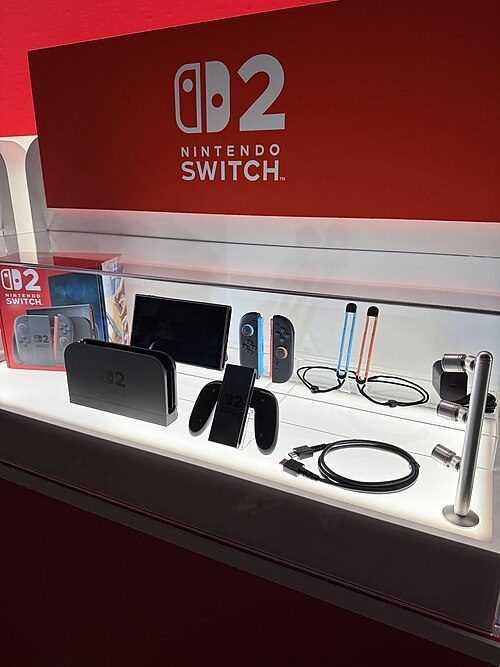
At the center of Nintendo Switch 2 lies a custom system-on-chip codenamed NVIDIA T239, derived from an optimized branch of NVIDIA's Ampere graphics architecture. In contrast to the original Tegra X1 processor with its modest 256 CUDA cores, the T239 incorporates 1,536 CUDA cores paired directly with dedicated Tensor Core neural processing units.
The integration of Tensor Cores enables native deployment of NVIDIA DLSS (Deep Learning Super Sampling). Rather than forcing mobile silicon to brute-force native 4K pixel rendering at unsustainable battery drain and thermal throttling, the system renders internally at 1080p or 1440p, allowing trained deep-learning models to reconstruct a crisp 4K output image when connected to a television via the dock. Bolstered by an expansive 12GB LPDDR5X RAM footprint delivering 102 GB/s memory bandwidth (vastly outstripping the 4GB capacity of the 2017 original), Switch 2 comfortably runs demanding modern titles built on Unreal Engine 5.
| Specification | Nintendo Switch (2017) | Nintendo Switch 2 (2025/2026) |
|---|---|---|
| SoC Architecture | NVIDIA Tegra X1 (20nm/16nm) | Custom NVIDIA T239 (Ampere + Tensor Cores) |
| System Memory | 4GB LPDDR4 (25.6 GB/s) | 12GB LPDDR5X (102 GB/s) |
| Handheld Display | 6.2" LCD 720p 60Hz / 7.0" OLED | 7.9" LCD 1080p 120Hz (VRR & HDR10 supported) |
| Internal Storage | 32GB / 64GB eMMC | 256GB UFS (microSD Express expandable) |
| Docked Video Output | Up to 1080p 60Hz | Up to 4K 60Hz (HDMI 2.1 via DLSS) |
| Joy-Con Attachment | Mechanical slide rail | High-strength magnetic Neodymium latching |
2. 7.9-Inch 120Hz Display with Variable Refresh Rate (VRR)
On the portable front, the upgraded 7.9-inch 1080p Full HD LCD screen provides a substantial viewing area improvement. Narrower borders maximize active real estate without expanding overall chassis ergonomics beyond comfortable handheld grip proportions.
Crucially, incorporating a 120Hz refresh rate alongside Variable Refresh Rate (VRR) technology fundamentally transforms portable responsiveness. VRR continuously synchronizes display refresh cycles directly with incoming GPU rendering frames. Consequently, whenever graphics-heavy scenes fluctuate between 45fps and 60fps, players experience unbroken visual fluidity free from annoying micro-stutters and screen-tearing artifacts.
3. Magnetic Joy-Con Couplings and Hall-Effect Anti-Drift Analog Sticks
Addressing the mechanical vulnerabilities of the preceding generation, Nintendo's hardware team overhauled controller ergonomics and internal assemblies from the ground up:
- Rail-less Magnetic Attachment: Joy-Con 2 controllers attach to the main console frame utilizing high-strength Neodymium electromagnets, providing rock-solid rigidity that releases smoothly with an electronic decoupling release button.
- Hall-Effect Sensors: Traditional carbon-contact potentiometer sticks have been replaced with non-contact Hall-effect electromagnetic sensors. Eliminating physical frictional wear inside the joystick assembly permanently eradicates stick drift issues.
- Enhanced HD Rumble 2 and Programmable Paddles: Additional tactile micro-switches grace the rear grip plates, alongside refined haptic voice-coil actuators delivering subtle textural feedback down to individual footsteps.
4. Ultra-Fast UFS Storage and Seamless Backward Compatibility
One of the primary frustrations of the original hardware was sluggish asset decompression from legacy eMMC flash and UHS-I microSD cards (typically limited to 60–95 MB/s). The Switch 2 transitions to 256GB of high-speed UFS solid-state storage, surpassing transfer speeds of 1,200 MB/s. Memory card expansion upgrades to the microSD Express protocol, reducing heavy game level load times from dozens of seconds down to momentary transitions.
In terms of software continuity, Nintendo guarantees backward compatibility across the vast library of over 10,000 legacy Switch releases in both physical game card and digital Nintendo eShop formats. Leveraging surplus silicon headroom, landmark titles including The Legend of Zelda: Tears of the Kingdom and Xenoblade Chronicles 3 automatically unlock rock-solid 60fps performance and cleaner rendering resolutions without requiring mandatory remaster purchases.
Sources: Nintendo Corporate Information, NVIDIA Developer Technical Notes, Digital Foundry Hardware Analysis.