Captain Tsubasa is a football manga by Yoichi Takahashi, first published in Weekly Shonen Jump in 1981. It follows Tsubasa Ozora from an elementary school pitch to his dream of winning the World Cup for Japan, and many famous players say it sparked their love of the game.
Overview
Tsubasa Ozora is an 11-year-old who loves football so much that he carries a ball everywhere. He has one huge dream: to help Japan win the World Cup for the first time. The story opens on an elementary school pitch in Japan, where he meets the teammates and rivals who will stay with him for years.
The early journey follows school tournaments. Tsubasa and Taro Misaki form a close pair for the Nankatsu team, then face players like goalkeeper Genzo Wakabayashi and striker Kojiro Hyuga. Later, Tsubasa moves abroad to play in Sao Paulo and Barcelona.
What makes it different is the timing. It began when Japan had never played in a World Cup. Takahashi has said he watched the 1978 World Cup on TV and wanted football to become more popular in Japan. So the series is both a sports story and an invitation to the game.
Highlights
It made many people love football
According to Al Jazeera, Andres Iniesta, Fernando Torres, David Villa and Lukas Podolski have linked their love of the game to the series.
Many sequels over 40 years
After the original 1981 to 1988 run came World Youth, Road to 2002, Golden-23, Kaigai Gekito-hen and Rising Sun, running until 2024 (per Wikipedia).
Several different anime
The first TV anime aired 1983 to 1986 with 128 episodes. David Production made a reboot in 2018, and Studio Kai made season 2 from October 2023.
A whole game line of its own
The first game came out on the Famicom in 1988. Recent ones include Rise of New Champions (2020) and Captain Tsubasa: Ace (2023), per Wikipedia.
Characters
Tsubasa Ozora
Main characterAn 11-year-old football prodigy who dreams of winning the World Cup for Japan. Later he moves to Sao Paulo and Barcelona to play.
Taro Misaki
Best friend and teammateTsubasa's close friend. The two form the Golden Duo of the Nankatsu team.
Genzo Wakabayashi
Goalkeeper, early rivalA talented goalkeeper and one of Tsubasa's earliest rivals in the first tournaments.
Roberto Hongo
CoachA Brazilian star who becomes Tsubasa's mentor and coach.
Kojiro Hyuga
Striker, major rivalA striker from Toho Academy and one of Tsubasa's biggest rivals.
Where to start
To understand the roots, read the original 37-volume manga (1981 to 1988), because every later part builds on it. If you would rather watch, the 2018 anime by David Production is a short way in with modern visuals. In Vietnam, look for the Kim Dong edition called Tsubasa - Giac mo san co.
- Original run, 1981 to 198837 volumes in Weekly Shonen Jump. This is where Tsubasa grows up from the school pitch.
- World Youth (1994 to 1997)18 volumes, continuing the story at the international youth level.
- Road to 2002 and Golden-23The next two parts, 15 and 12 volumes, in publication order.
- Rising Sun (2013 to 2024)20 volumes. Tsubasa aims for the Olympics; it is the latest part published in volumes.
Is it for you?
It's for you if
- You like sports manga and want the series that opened the door for football stories.
- You love football and wonder why so many players mention this series.
- You enjoy long, multi-part stories with many rival characters.
It may not suit you if
- You dislike sports stories with long, drawn-out matches.
- You want a short series you can finish in a few volumes.
- You want realistic football; the series tells it in a deliberately exaggerated way.
Timeline
- 1981Captain Tsubasa begins in Weekly Shonen Jump on March 31.
- 1983The first TV anime debuts and later reaches 128 episodes.
- 1988The original run ends on May 9; the first game arrives on the Famicom.
- 1994World Youth starts in Weekly Shonen Jump.
- 2013Rising Sun begins in Grand Jump in December.
- 2018David Production makes a new anime ahead of the Russia World Cup.
- 2024Takahashi announces he will stop serializing; Rising Sun ends at 20 volumes.
Quick answers
How many Captain Tsubasa manga volumes are there?
The original 1981 to 1988 run has 37 volumes. Later parts such as World Youth (18), Road to 2002 (15), Golden-23 (12), Kaigai Gekito-hen (8) and Rising Sun (20) are separate series, per Wikipedia.
How many copies has Captain Tsubasa sold?
Wikipedia says over 90 million copies were in circulation worldwide by 2023. Al Jazeera in 2022 said over 80 million, so the figure grows with the date it was measured.
Is Captain Tsubasa the same as Oliver y Benji?
Yes. Al Jazeera says the channel Tele5 brought the anime to Spain in 1990 as Oliver y Benji. Tsubasa Ozora is called Oliver Atom there.
Is Captain Tsubasa still being drawn?
Takahashi announced in 2024 that he would stop serializing. Rising Sun Finals continues as web storyboards since July 2024, paused after chapter 100 in May 2026, and is set to resume on October 6, 2026, per ANN.
Sources for this overview: Wikipedia: Captain Tsubasa · Al Jazeera: Who is Captain Tsubasa? · Anime News Network: Rising Sun FINALS resumes · FC Barcelona: The creator of Captain Tsubasa visits FC Barcelona
Overview
Captain Tsubasa is Yoichi Takahashi's football manga about Tsubasa Ozora, a boy obsessed with football who dreams of leading Japan to a World Cup title. In Vietnam it is published by Kim Dong as Tsubasa - Giấc mơ sân cỏ.
OtaHub's take
According to Al Jazeera, players such as Andrés Iniesta, Fernando Torres, David Villa and Lukas Podolski have said their love of football began with this series. According to FC Barcelona, one of the main characters later represents a fictional Catalan club inspired by Barça.
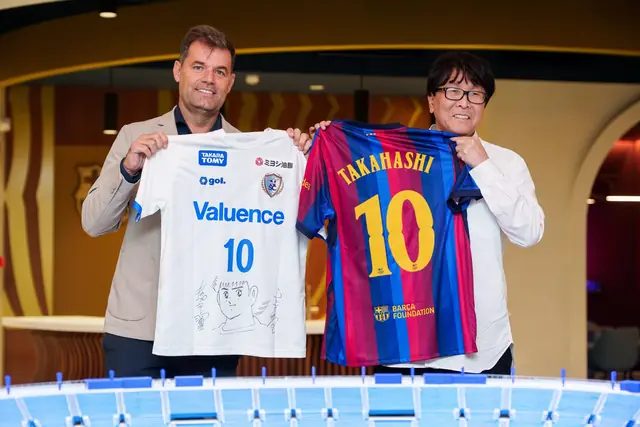
Takahashi announced the end of serialised work in 2024, when Captain Tsubasa Magazine released its final issue. Captain Tsubasa: Rising Sun FINALS continued as storyboards on the Captain Tsubasa World website from July 2024, went on hiatus in May 2026 and was announced to resume on 6 October 2026. On 5 October 2026, Takahashi visited FC Barcelona and drew Lamine Yamal in manga style.
Verdict
Captain Tsubasa is essential reading for sports manga fans and for football fans who want to understand why the series is seen as a cultural bridge between Japan and world football.