In-Depth · Characters · Light spoilers (through episode 14 of season 1)
Frieren: Beyond Journey’s End has a love story nobody says out loud. Himmel, the hero who has died, never tells Frieren he loves her. In OtaHub’s reading, he leaves three things instead of words: a statue, a ring and a moment under a clock tower. This essay reads those details as a way of telling a story about time: Himmel lives briefly, and Frieren lives very long.
Quick background
- Himmel is the hero who led the party that defeated the Demon King. He is human, blue-haired and cheerful.
- Frieren is an elf mage who lives for thousands of years. She traveled with Himmel’s party for 10 years.
- Himmel dies after that adventure. Most of the story follows Frieren’s journey after he is gone.
- The anime is by Madhouse, directed by Keiichirō Saitō, based on the manga by Kanehito Yamada and Tsukasa Abe.
Why does Himmel never say he loves her?
Himmel knows exactly who he is: an ordinary person who will grow old and leave this world. He also knows Frieren will live long after. So his way of caring for her is not sweet talk. It is looking after her day by day, and thinking ahead to when nobody is left beside her.
You can check this against the work itself. In an interview published on Shinseiki, composer Shoji Hata notes that the original never uses the word “love” in a romantic sense. Director Saitō answers that the only related thing is the mirrored lotus, and says that spelling the feeling out in the anime would feel tasteless. In other words, Himmel’s silence is a choice by the filmmakers, not an oversight.
What does the statue tell Frieren?
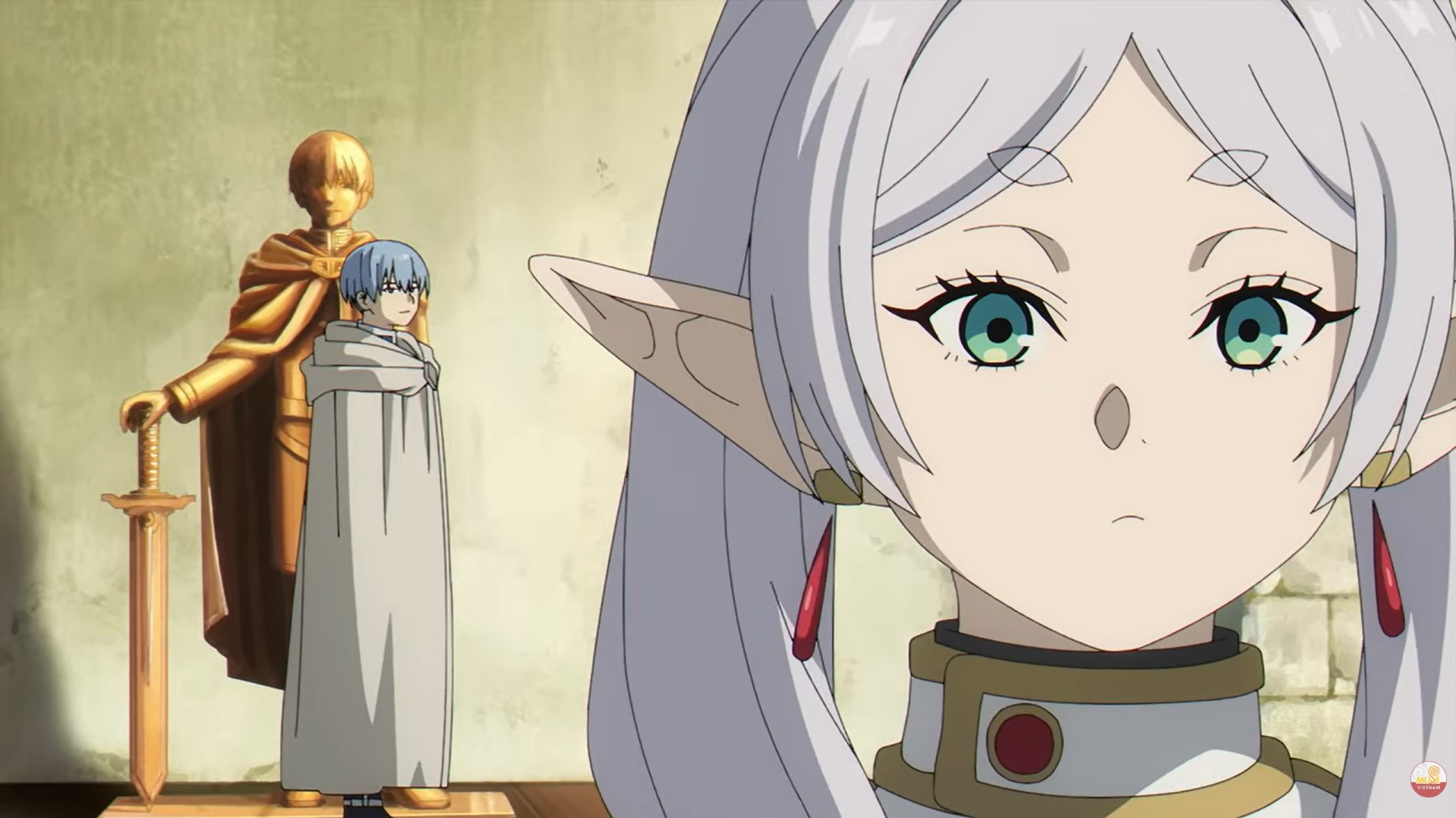
At first glance, the statues of the hero party exist so the world remembers them. Episode 7 gives another reason: Himmel had statues made in many places because he expected that one day Frieren would feel lonely. The statues are his way of staying: the friends who traveled with her for 10 years will always be standing there when she walks by.
It is a familiar paradox. Nobody beats time, and Himmel is no exception. But stone and bronze outlast people, and he uses that to push back against his own limits. What he did not foresee, and neither did Frieren, is how different their clocks really are.
What do the Mirror Lotus ring and the clock tower show?
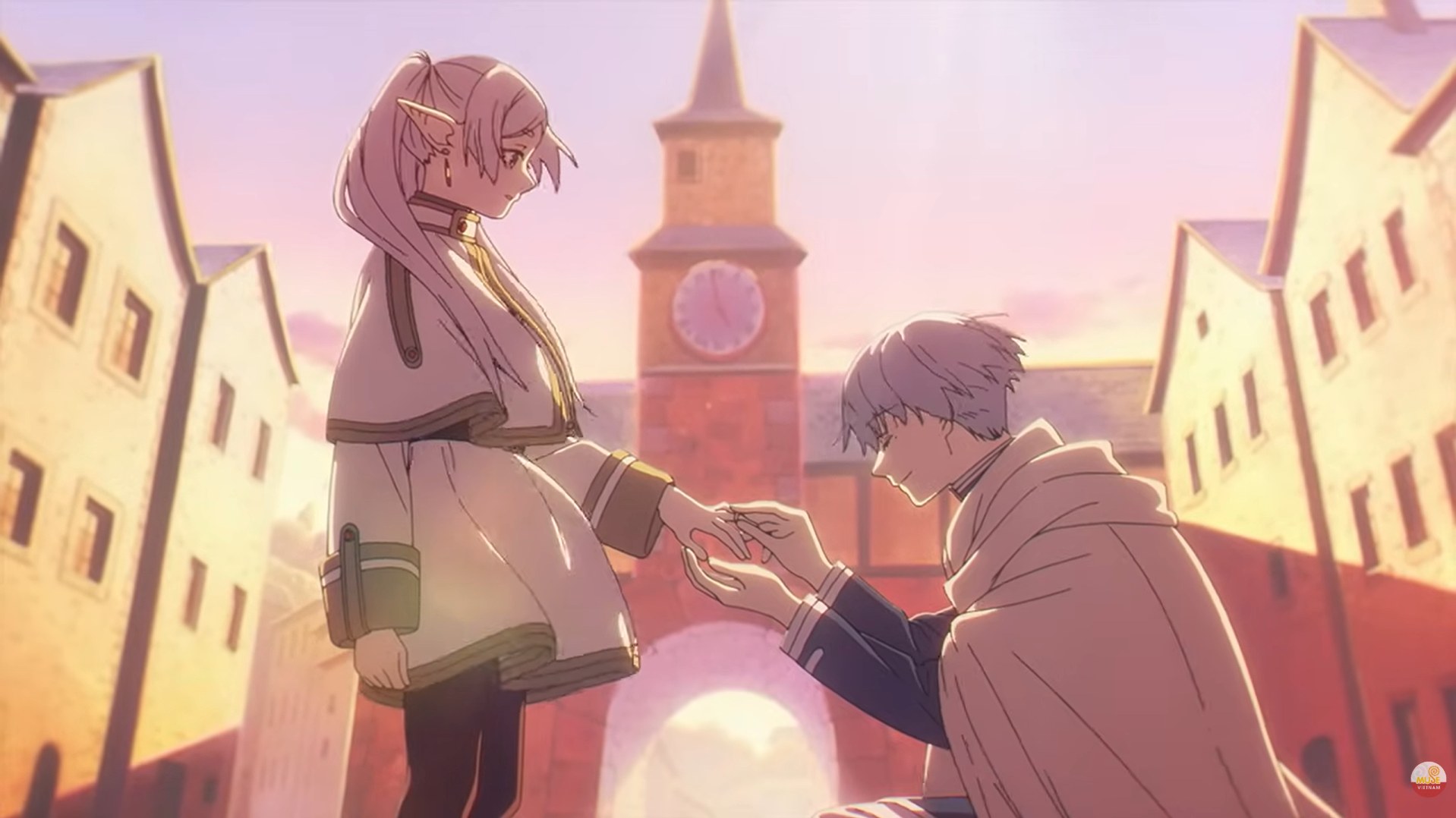
In episode 14, Frieren realizes the ring Himmel once gave her is no longer on her hand, and she remembers the moment he handed it over. The ring has a mirrored lotus (Mirror Lotus) pattern. According to Saitō, in this world’s flower language the mirrored lotus means eternal love. It is the most discreet confession Himmel could make, and Frieren did not fully understand it then.
That moment takes place under a clock tower. The tower is worth noticing because both the ring scene and Frieren’s memory of it are tied to it. In OtaHub’s reading, this is deliberate: if the goal were only a love story, there are more romantic settings than a street with a clock.
As for the bell in the scene, Saitō said the idea came from the episode director and storyboard artist Shinya Iino, that it is the city’s time signal, and that its meaning is left to the viewer. OtaHub reads it like this: the bell does not announce a love beginning, it only says time is passing. The moment of the ring is marked, and then it too becomes the past.
Why is the one left behind the one who lives with time?
The two stand side by side but measure time with different rulers. For Himmel, 10 years is a large part of his life, so he understands that every moment is finite. For Frieren, 10 years passes like a breeze. When he slips the ring on her finger, the clock is also counting down the days he has left.
That is why the clock tower does more than prove Himmel’s time is limited. It points to the biggest gap in Frieren’s understanding of people: she does not yet know how short their time is.
What Frieren loses when Himmel dies is more than a companion. She loses the chance to understand what he did for her while he was alive. The ring cannot be returned with an answer. The statue cannot talk back. Memories cannot be edited, and time cannot be rewound.

How does Frieren change after Himmel dies?
At the start, Frieren is rather cold and carefree, and has not bothered to learn about people. After Himmel is gone she changes slowly, even if late. Episode 2 is a small but clear example: asked to clean the statue of Himmel, Frieren remembers he loved a flower called Blue Moonweed, though she has never seen one herself. She spends months searching for it, plants it around the statue and places a flower crown on its head.
It matters because Frieren, who once paid no attention to people, now spends months on one small thing for someone who has died. That is a sign she has learned to care, even though Himmel is no longer there to receive it.
The other side
This reading has two weak points. First, it is OtaHub’s inference from how the images are built, not something the filmmakers have said. Director Saitō says plainly that whether Himmel loves Frieren is up to the viewer.
Second, someone could say the clock tower is just town scenery and the bell just a time signal, as the director put it. That could well be right. But it struggles to explain why the team chose exactly that detail for the ring moment, then had Frieren remember it somewhere else.
In short
The three details tell one story: Himmel’s feelings do not travel through words but through the things left behind after him. The statue keeps his presence, the ring keeps the feeling and the clock tower reminds us that every moment becomes the past. This essay shows that the three details fit the work’s theme of time. What it cannot show, and nobody can, is exactly what Himmel meant, because the filmmakers left it open.
Some feelings are never spoken. They sit in one person quietly looking after another. Frieren is learning to see that, later than Himmel hoped, but still in time to live on differently.
FAQ
Does Himmel love Frieren?
The anime does not say. Director Keiichirō Saitō said whether Himmel has romantic feelings for Frieren is up to the viewer, and that spelling it out in the anime would feel tasteless. The only related reference is the meaning of the mirrored lotus: eternal love.
What does the Mirror Lotus mean in Frieren: Beyond Journey’s End?
According to director Saitō, in the flower language of this world the mirrored lotus means eternal love. Himmel gives Frieren a ring with this pattern, and she does not understand the meaning at the time.
Which episode shows the Himmel statue?
Episode 7 explains why Himmel had statues made, and episode 2 shows Frieren returning to look after a statue of Himmel and planting flowers around it.
What does the clock tower in the ring scene mean?
The director said the bell in the scene is simply the city’s time signal and left the meaning to the viewer. OtaHub’s reading is that the clock tower reminds us that the moment will become the past.
Sources: Interview with Keiichirō Saitō and Shoji Hata (Shinseiki), Frieren Wiki: Episode 14, Frieren Wiki: Episode 2, DoubleSama: Frieren episode 7, images from Muse Vietnam.