In-Depth · Legacy & Retrospective · No spoilers
There was a time when playing a football game meant picking a side: FIFA or Pro Evolution Soccer. In Vietnam, people simply said “đá PES” (“playing PES”). Today the PES name is no longer on the disc. In OtaHub’s view, PES peaked on gameplay rather than licences, then faded because of those same licences and mistimed decisions by Konami.
Quick facts
| Milestone | Details |
|---|---|
| December 1995 | Goal Storm launches in Europe and North America; in Japan it is World Soccer Winning Eleven (1996) |
| October 2001 | Pro Evolution Soccer launches on PlayStation and PS2 |
| 2009 | PES 2009 is the first with the UEFA Champions League licence |
| 2019 | PES 2019 is the first in 10 years without the UEFA competitions |
| September 30, 2021 | eFootball launches free-to-play to very poor reviews |
| August 14, 2025 | eFootball 2026 season launches |
Where did PES begin?
PES did not appear from nowhere. It descends from Konami’s International Superstar Soccer (ISS) line, which began in 1994 on the SNES. According to Wikipedia, Goal Storm launched in Europe and North America on December 22, 1995 and in Japan as World Soccer Winning Eleven, while J.League Jikkyou Winning Eleven came out earlier, in July 1995, in Japan only. In 1997, ISS Pro on PlayStation brought a new 3D engine and nine in-match tactics options. Wikipedia calls it a game-changer.
Pro Evolution Soccer launched in October 2001 on PlayStation and PS2, called World Soccer: Winning Eleven 5 in Japan. If you remember PES arriving just five years after Goal Storm, that needs a small correction: the real gap is nearly six years, with the ISS Pro games in between. Names also varied by region: according to Thế Giới Di Động, from 1997 to 2000 Konami called the game ISS Pro in Europe and Winning Eleven in the rest of the world.
Why was PES a hit in the PS2 era?
The reason mentioned most often is gameplay. According to Wikipedia, citing The Guardian, PES was known for faster, more tactical play and more varied emergent moments. PES 2 added a training mode, and PES 3 (2003) overhauled the graphics and added growth and decline curves for players, meaning players could rise in form and then fade with age. Later came Teamvision (PES 2008), which lets teammates on the pitch adapt tactics to the situation.
In Vietnam, according to Thế Giới Di Động, the phrase “đá PES” dates back to the PlayStation 1 and 2 and is tied to many gamers’ childhoods. The source gives no popularity figures, so OtaHub will not claim how far PES beat FIFA in Vietnam. What can be said safely is that the name is tied to many people’s memories.
On sales, Wikipedia says PES had sold over 10 million units by 2002, while FIFA had already sold over 16 million by 2000. So PES was never the volume leader, even if its gameplay was often praised. The whole series is credited with about 111 million copies sold and 400 million mobile downloads as of December 2020.
Were the “fake” names really its charm?
This is the part people miss most. Lacking licences, PES gave fake names to many teams and players. Wikipedia notes that in PES 2 (2002), Dutch players were named generically “Oranges” because Konami lacked the rights from the Dutch federation, and clubs such as Manchester United were renamed vaguely. By PES 4 (2004), clubs like “Man Red” appeared.
The best-known example is R. Larcos, a shaven-headed Brazilian left-back with a distinctive free-kick run-up, clearly a nod to Roberto Carlos. Planet Football says he was often the first pick in Master League for his speed and stamina, and the player you gave free kicks to because they could produce spectacular goals. The same article says the fake players did not share names with the real ones but were easy to tell apart by appearance and style. Other examples are Oranges005, a dreadlocked Dutch international, and Gigsi, a left-footed Welsh winger.
The question is whether those names are what made PES special. OtaHub thinks only partly. They were a lovable quirk, but they existed because Konami lacked licences, and Konami also kept buying more over time. Wikipedia shows this happened step by step rather than starting in 2010 as many remember: PES 3 (2003) already had licensed Italian clubs such as Milan, Lazio, Roma and Juventus, PES 2009 was the first with the UEFA Champions League, then PES 2010 added the Europa League and PES 2011 added the Copa Libertadores.
Why did PES lose ground in the 2010s?
There is no single reason. According to Wikipedia, FIFA pulled ahead in the early 2010s, after PES 2008 was received poorly (on PS3 it had frame-rate problems and a weaker editor) while FIFA 08 was received better. On top of that, EA won the UEFA competitions: PES 2018 was the last with the Champions League, Europa League and Super Cup, and PES 2019 was the first in 10 years without them.
It shows in the numbers. According to some reports, PES’s worldwide sales in 2018 were only about 550,000 copies against FIFA’s 12.2 million, but that figure comes from press reports and has not been confirmed by either company. Konami has a strength elsewhere: on phones, according to an aggregator, total eFootball downloads passed 950 million.
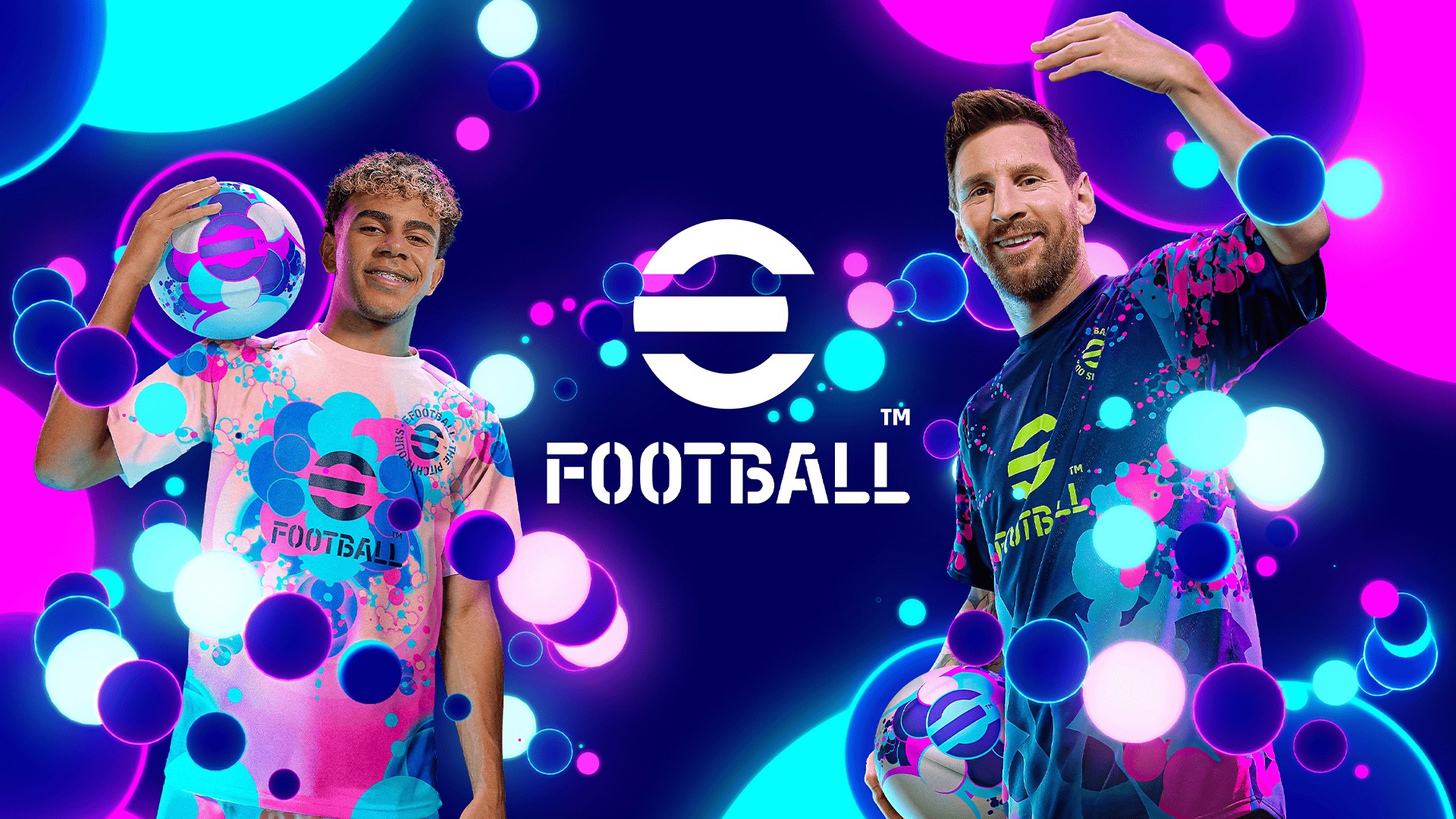
Konami also changed direction itself. PES 2020 (September 10, 2019) carried the name “eFootball PES 2020,” and on September 30, 2021 the series became simply eFootball, free-to-play and built on Unreal Engine 4. Wikipedia says the game was panned for its graphics, received 92% negative reviews on Steam and scored just 25/100 (PC) and 34/100 (PS5) on Metacritic. Konami apologized and released the 1.0 update on April 14, 2022, with the mobile version following on June 2, 2022. As of September 2024, according to Wikipedia, Master League and Edit Mode were still not available on PC and consoles.
Meanwhile the competition changed. According to several outlets, EA and FIFA did not renew their licence, and EA released EA Sports FC 24 on September 29, 2023, its first football game without the FIFA name.
Music and other memories
Music is part of the memory too. Wikipedia notes PES 2 used Queen: “We Will Rock You” as the opening and “We Are the Champions” when a team won. According to Giant Bomb’s track list, PES 2010 included two songs by Klaxons and two by Kaiser Chiefs, and PES 2008 had used a Kaiser Chiefs song for its intro. OtaHub found no source confirming The Temper Trap appeared in PES, so that name is not included.
The other side
Two things deserve caution before calling PES a “forgotten legend.” First, most praise for its gameplay comes from nostalgia and opinion, with no objective yardstick. FIFA also had very beloved editions, and according to Wikipedia FIFA outsold PES from the early years. Second, the view that “PES lost its identity when it bought licences” is a nice reading but not necessarily right. Players later got real names, and that may be what many wanted, as Konami kept trying to buy more licences for years.
Saying PES “faded” is also incomplete: the eFootball series still runs, the 2026 season launched on August 14, 2025, and Konami released eFootball Kick Off! on Switch 2 on June 3, 2026. Only the PES name and the old discs are gone.
In short
This piece shows three things with evidence: PES became famous on fast, tactical gameplay; it lacked licences in its early years, which produced fake names players still remember; and it faded when it lost the UEFA licences, lost the race with FIFA, then entered the eFootball era with a poor launch. What it does not show is that PES ever outsold FIFA in Vietnam: the Vietnamese source only calls it a memory for many people. Perhaps the right way to remember PES is both ways: a very good game, and an example that gameplay quality alone is not enough to win the licensing race.
FAQ
When was Pro Evolution Soccer released?
October 2001 on PlayStation and PlayStation 2. In Japan, the game was called World Soccer: Winning Eleven 5.
Why did PES use fake player names?
Because Konami lacked licences for many teams and players. In PES 2, for example, Dutch players were named generically “Oranges,” and the Brazilian left-back R. Larcos was recognizable by his free-kick run-up, like Roberto Carlos.
When did PES become eFootball?
The name “eFootball PES” began with PES 2020 (September 10, 2019). In 2021 the game became eFootball, which launched on September 30, 2021 as a free-to-play title.
Does PES still exist?
Not under the PES name. Konami continues with eFootball, and the 2026 season launched on August 14, 2025. Konami says eFootball downloads have passed 950 million, mostly on phones, according to an aggregator (OtaHub could not open the original).
Sources: Wikipedia: Pro Evolution Soccer, Wikipedia: eFootball, Planet Football: R. Larcos, Thế Giới Di Động: What is PES, Giant Bomb: PES 2010, Konami eFootball.