Humankind is a turn-based strategy game in the 4X genre (four X's: explore, expand, exploit and exterminate), made by Amplitude Studios and released on 17 August 2021 for PC. You lead a nation through six eras of history, from nomadic life to the modern age, so many players put it next to Civilization VI, the best-known game in the same genre.
The biggest difference is "culture". In Civilization VI you pick a people and keep it from start to finish. In Humankind, each time you enter a new era you choose again from ten cultures of that era, 60 cultures at launch to combine. The idea is genuinely new, and the civic system and surprise events are well done. In return, the AI (the computer-controlled rivals) and diplomacy drew criticism from the start, and five years later that criticism has not fully gone away.
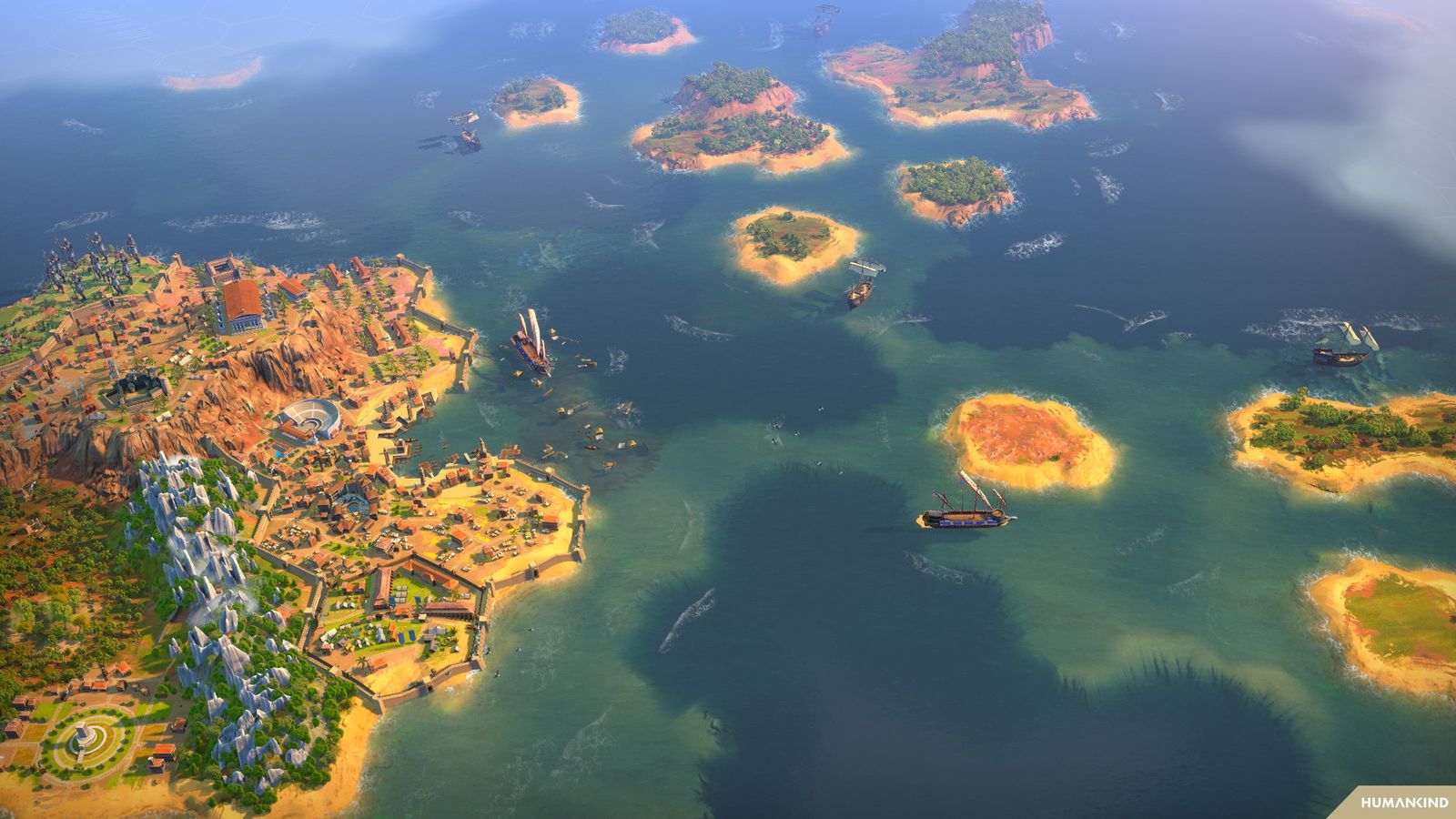
Quick facts
| Item | Details |
|---|---|
| Developer | Amplitude Studios |
| Publisher | Sega at launch; since November 2024 Amplitude is independent again and the Steam page lists Amplitude Studios |
| Release date | 17 August 2021 on Windows; macOS 3 November 2021; PS4, PS5, Xbox One, Xbox Series X|S 22 August 2023 (Together We Rule expansion 9 November 2022) |
| Platform | Windows, macOS, PlayStation, Xbox; the writer's hands-on play was the PC version at launch |
| Price | 731,000 VND (list price, Vietnamese Steam store); 75% off at 182,500 VND on 9 October 2026 |
| Languages | English (with voice-over), French, German, Spanish, Polish, Russian, Chinese, Brazilian Portuguese, Korean, Italian, Turkish; no Vietnamese |
| Length | No official figure; the writer played more than 70 hours, including one session of nearly 12 hours |
| Where to play | Steam (PC, Mac), PlayStation Store, Xbox store |
| Critic scores | Metacritic 77/100 (PC, 55 reviews, as of 9 October 2026); Metacritic user score 6.7/10; Steam 69% positive across 28,877 reviews, while the 100 most recent reviews (9 September to 9 October 2026) are 77% positive |
Review scope
The play experience in this review comes from the writer's notes after more than 70 hours played from the game's August 2021 launch. OtaHub cross-checked it against launch-era reviews, 2023 console reviews, Amplitude's official update announcements on Steam, and current Steam and Metacritic scores. OtaHub has not replayed the latest version.
That matters because the game has changed a lot. Amplitude says it has shipped more than 15 major updates, reworked the resource and trade system, expanded how you deal with independent peoples and grown the roster to 86 cultures. So every comment on the AI, trade or balance below says whether it comes from the 2021 version, from a particular review, or from Amplitude itself.
More than 70 hours played since launch, including one session of nearly 12 hours without a break, the same pull as Civilization VI. The longest game went through six eras with six cultures, starting with the Olmecs and switching to the Huns in a later era. The writer still prefers Civilization VI but finds Humankind different enough to be worth trying.
Gameplay: is switching cultures every era a good idea?
Each culture in Humankind has its own bonuses and penalties. When you finish an era, you carry on by choosing a new culture for the next one. The yardstick for progress is the Era Stars: each star is a small goal along the lines of farming, building, trade or military. Completing goals earns rewards and Fame points. When the preset number of turns runs out, the player with the most Fame wins.
The best part is that you are not tied to a single people. The writer started with the Olmecs, switched to the Huns in a later era, and kept combining through six cultures in one game. Your nation feels more like a collection than a fixed name, and you decide each piece. Several reviews also single this out as the game's best idea.
The catch is that every switch is also a little forgetting. By the final era the writer had almost no memory of the five earlier cultures. It is not a big flaw, but it leaves the nation without a lasting identity, and that identity is exactly what the game is selling. One review worries about the opposite problem: a culture choice can sometimes box you in, and a player who is behind may find the best options already taken.
You can customize the avatar that represents your nation, which is a fairly new idea in 4X games. Unfortunately that character stays almost the same through every era and every culture, so there is no sense of a leader growing up with the nation.
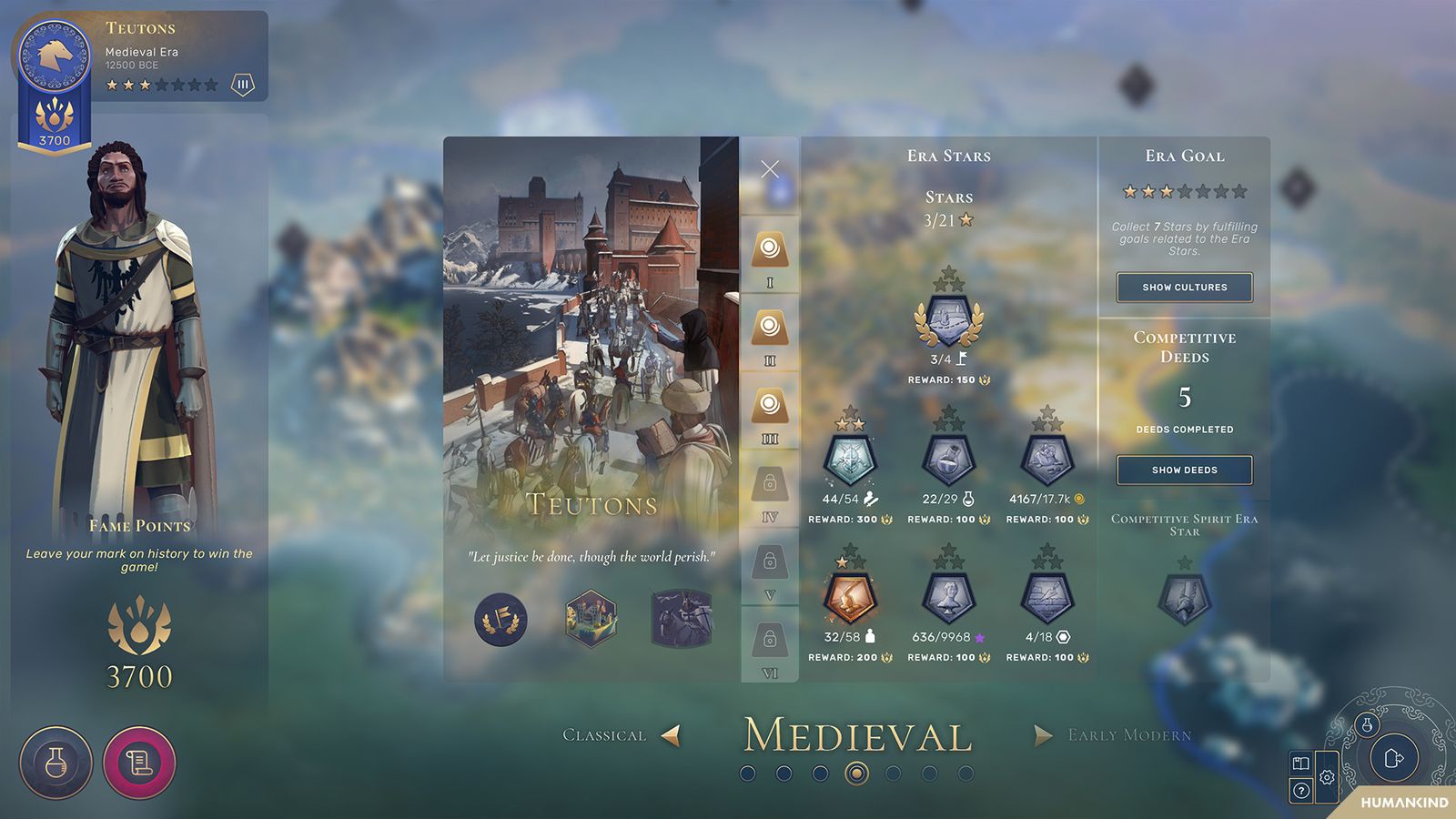
Switching from the Olmecs to the Huns mid-game
After finishing the first era as the Olmecs, the writer picked the Huns for the next. That is when you realize you are no longer playing "one people" but rewriting history by stitching cultures together.
OtaHub likes this moment because it shows the game's core idea working in the player's hands, not just on the store page. What stays unresolved is that the more you switch, the harder it is to remember who you used to be.
Game systems: how do expansion, civics and trade work?
The foundation of Humankind looks like Civilization, so veterans feel at home at once. Each tile yields a resource: food, industry or science. Enough food grows your population and more industry builds things faster. This is largely the standard template for turn-based 4X games, so OtaHub does not go deep on it.
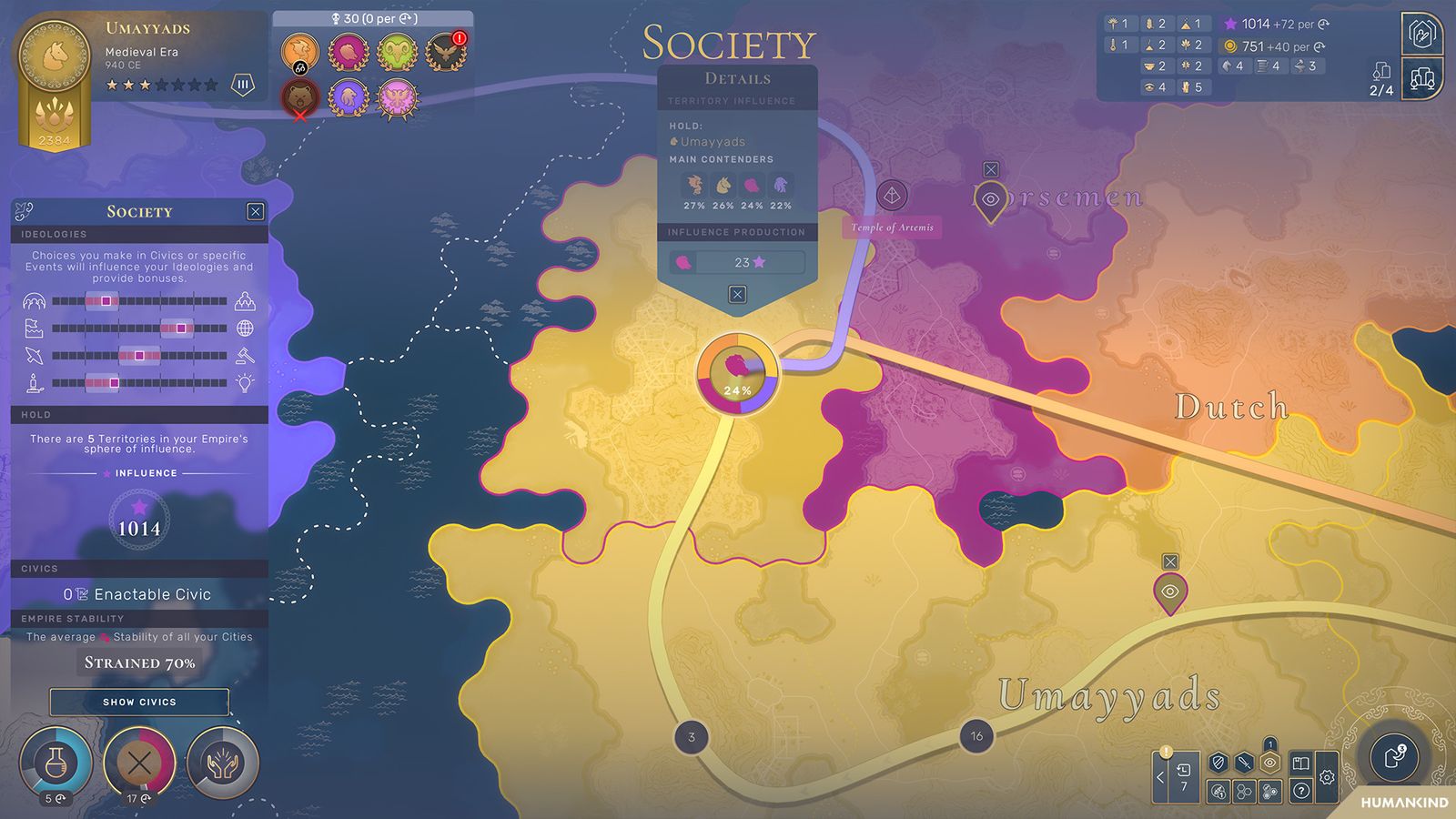
The more interesting part is the limit on cities. You can only control a certain number of cities. Go over it and Influence (a resource used to expand and govern) drops, and stability inside each city gets tense. The Society screen in the official images even shows the average stability of the whole nation (in the image it reads "Strained 70%"). OtaHub finds this close to reality: expand too fast and you struggle to rule.
The civic system is the smartest thing Amplitude built. The Society panel lets you choose Civics (policies), and according to the in-game description, your choices there or in events shift your Ideologies and bring bonuses. It lets you step into customs and daily life, not just build houses and research science. The surprise events mid-game, where you have to pick how to resolve them, also deserve praise.
Trade, by contrast, was the weakest part for the writer in 2021. Exchanges between nations were over-automated, you could only accept or refuse, and the home economy got little attention. That area has since been reworked: according to Amplitude's preview of the Anne Bonny update (2023), trade between empires now always connects capitals, routes carry upkeep costs, and armies or navies can poach trade routes. OtaHub has not replayed this part, so it cannot say whether the result is truly deeper.
Combat and AI: is fighting worth your time?
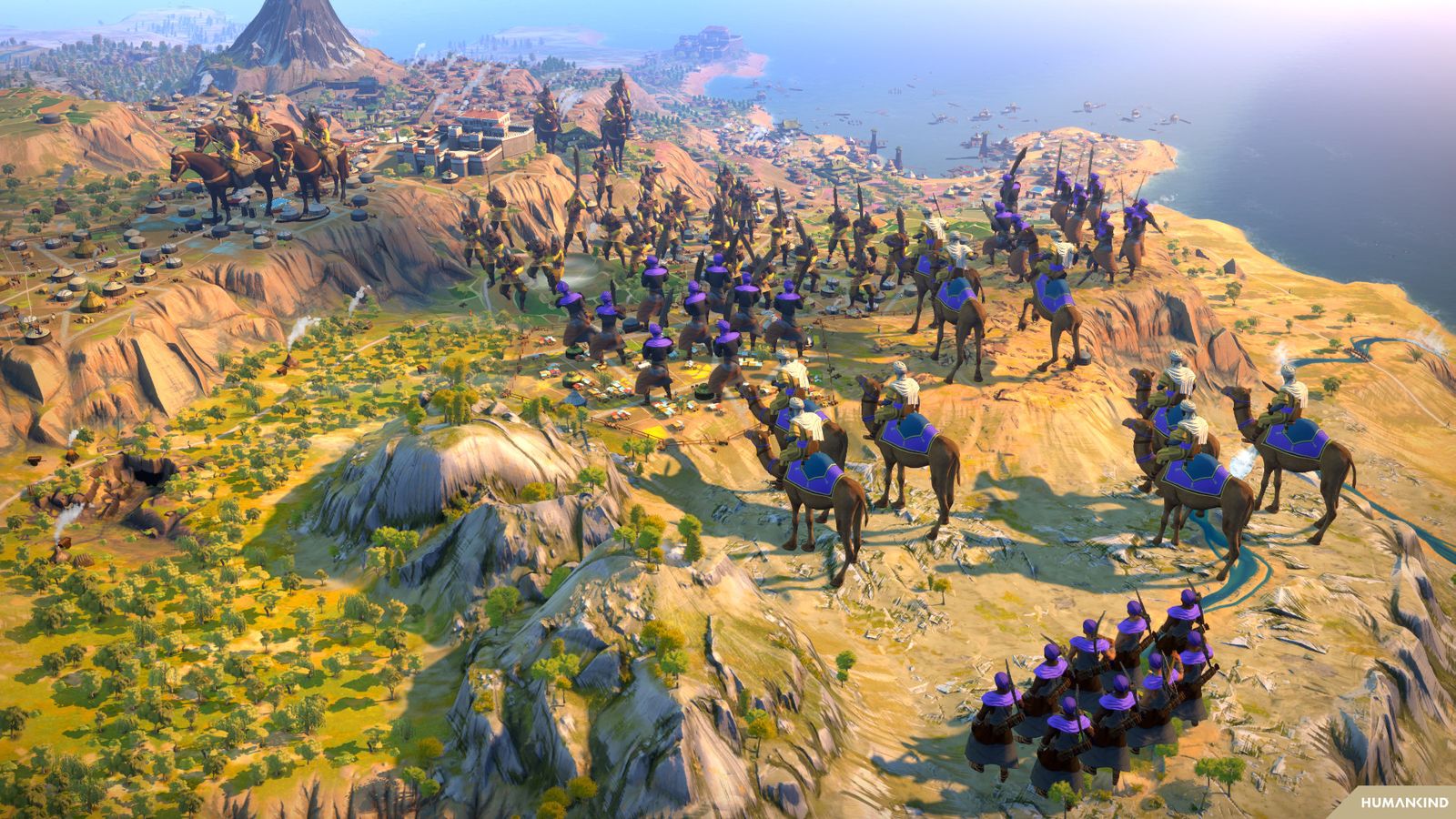
Combat is probably Humankind's biggest plus over Civilization. When two sides meet, the game switches to a separate tactical mode where terrain and unit abilities matter. A fight therefore has room for thought instead of comparing numbers and pressing attack. A launch-era review also rated combat as a highlight and found the in-battle AI fairly competent.
The strategic AI is another matter. In more than 70 hours the writer only saw the AI raid outposts (small settlements that are not yet cities) and stop, never actively widening a war. The result is that the motivation to build an army disappears, and the writer put everything into Fame and technology. The launch-era review said the strategic AI is weaker than the in-battle AI, while a 2023 PS5 review found the AI erratic: allies suddenly refusing treaties or declaring war at random, and more aggressive on higher difficulties. In other words, "the AI is too tame" is probably only partly true and may depend on difficulty.
Amplitude has tuned the AI several times: how it handles faith, influence and early expansion (Vauban update, April 2023), and how it handles embarked units and air strikes (April 2026). The war system was also reworked in the Achilles update (February 2025): both sides can now keep fighting even after "war support" (the stamina for a war) reaches 0, instead of being forced to stop. OtaHub has not tried these changes, so it does not know whether they fix the reluctant-AI problem.
One more annoyance in the 2021 version: independent peoples and breakaway states spawned very quickly. Even after suppressing and absorbing many of them, they kept surrounding your nation. The update that shipped with Together We Rule later reworked how you deal with independent peoples, according to Amplitude.
Story and world: does human history become a story?
Humankind has no fixed story. The world is generated randomly each game, and the "story" is the history you assemble across six eras, with historical figures and events woven in. That suits a 4X game, but it puts the burden on the culture-switching mechanic itself: if you do not remember who you were, the story falls apart with it.
That is why this category gets the lowest score in the rubric. The random events have charm and the avatar can be customized, but no thread ties six eras into a memorable narrative.
Graphics and sound: is it easy to follow?
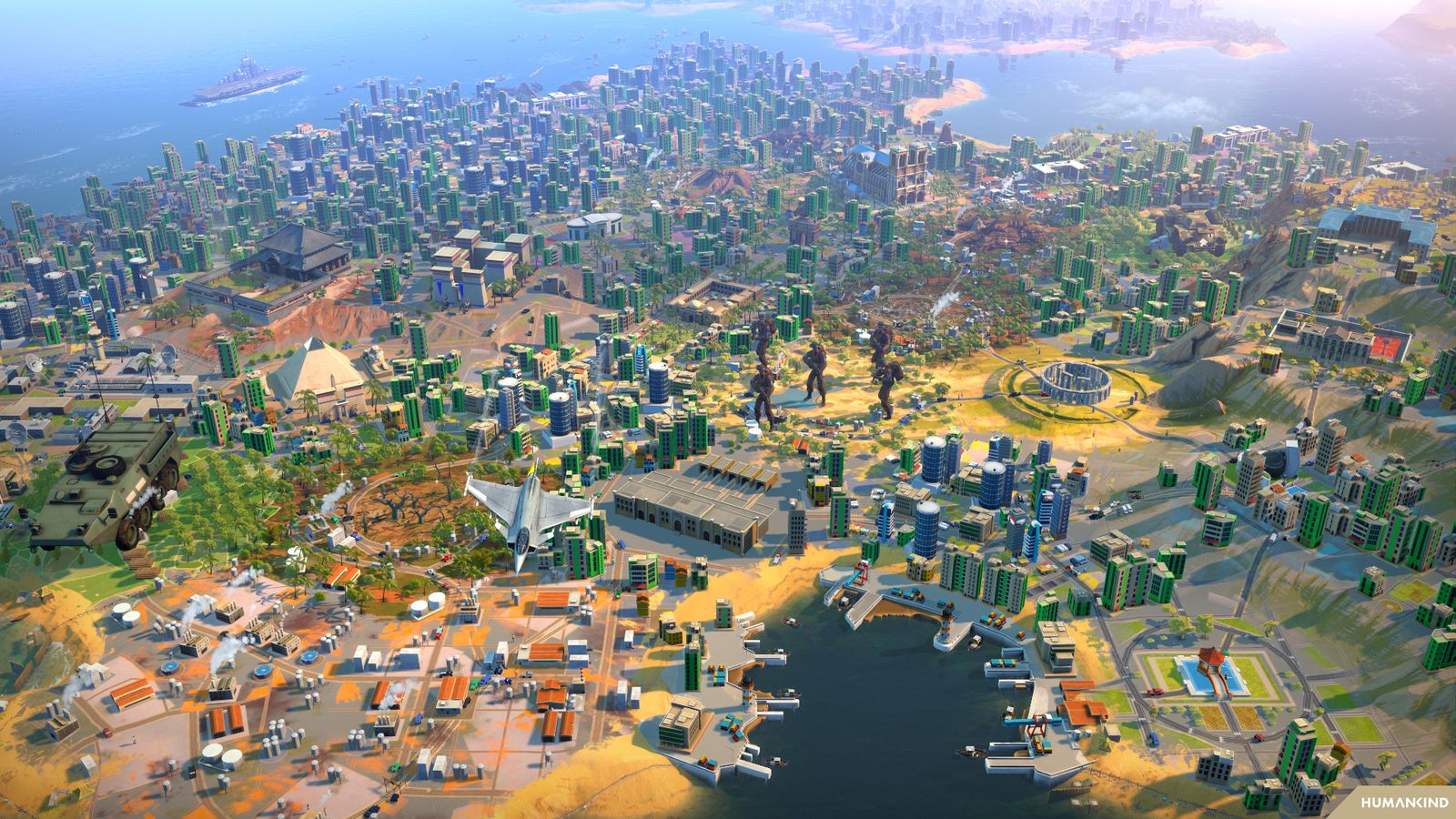
The writer's notes do not cover this in depth, so OtaHub relies on official images and reviews. What stands out is how cities change shape from era to era: from a patch of ground with a few ancient roofs to a modern skyline where a pyramid and a stone ring resembling Stonehenge sit between skyscrapers. The colors are vivid, but a launch-era review noted that the map can get busy and small details like stone fields or cliffs are easy to miss. The 2023 console review found the visuals decent but not wondrous, with settlements upgrading cosmetically rather than changing fundamentally.
On sound, only one launch-era review comments: it praised the music as strong enough to rival Civilization's score. One source is thin, so OtaHub scores this category moderately.
Technical performance: what PC do you need?
The Steam minimum is not high: Windows 7 64-bit, an Intel Core i5 (4th generation) or AMD FX-8300, 8 GB of RAM, a GTX 770 or R9 290 graphics card, DirectX 11 and 25 GB of free storage. According to Wikipedia, Amplitude dropped Denuvo (an anti-piracy tool) after test data showed it hurt performance, a decision that benefits players.
A launch-era PC review hit no frame drops or serious bugs but criticized the graphics presets-only options and long loading screens. The writer's near-12-hour session also reported no notable bugs. On console, the 2023 PS5 review found the tutorial buried in text, the unit selection clunky and the manual battle mode confusing. The game also needed many fixes after launch, for example the Shackleton update (January 2023) fixed turns that could hang.
Content and value: is it worth the money?
For sheer content, this is Humankind's strongest category today. The game launched with 60 cultures; according to Amplitude it now has 86, including add-on packs and the Together We Rule expansion (9 November 2022, which added agents, embassies and the Congress of Humankind for diplomacy). There are also scenarios such as Terra Incognita and War in the Pacific, mod tools, and a random world every game.
What lowers the value is the 731,000 VND list price, which is high for a game whose AI and diplomacy still draw criticism. Fortunately it is often discounted deeply: on 9 October 2026, for its fifth anniversary, it was 75% off at 182,500 VND. At that price it is much easier to try.
For players in Vietnam
- Vietnamese
- Not available. The game offers English (with voice-over), French, German, Spanish, Polish, Russian, Chinese, Brazilian Portuguese, Korean, Italian and Turkish.
- Price
- 731,000 VND list price on the Vietnamese Steam store. On 9 October 2026 it was 75% off at 182,500 VND; sale prices change with each promotion.
- Hardware
- Minimum Windows 7 64-bit, i5 (4th generation) or FX-8300, 8 GB of RAM, GTX 770 or R9 290, 25 GB of storage. macOS, PlayStation and Xbox versions exist.
- Play time
- A full game takes many hours, so it suits playing in sessions, although the writer once sat for nearly 12 hours straight.
- Wait for Humankind 2?
- Amplitude announced Humankind 2 on 25 August 2026, planned for 2027. If you want to try the genre now, the first game has plenty of content; if you only want the newest version, you can wait.
What critics say, and where OtaHub differs
Metacritic gives the PC version 77/100 (55 reviews, as of 9 October 2026), a "generally favorable" rating. IGN scored it 7/10 and called it an interesting but fairly safe take on historical 4X. PC Gamer gave 71/100 and found it too number-driven. Cultured Vultures gave 7.5/10, praising the idea and the combat but faulting the balance. Kotaku praised mid-game culture switching as the smartest new idea, while Rock Paper Shotgun felt that neither diplomatic nor military play is rewarded much. The Metacritic user score is 6.7/10; Steam has 69% positive across more than 28,000 reviews, but the 100 most recent reviews rise to 77%.
OtaHub lands close to the critics' average and above the writer's original 6/10. The reason: the 6/10 was for the 2021 version, while the game today has more content and many reworked systems. OtaHub does not go higher because the two weaknesses almost every review mentions, thin diplomacy and an erratic AI, are still being mentioned in more recent write-ups.
Who should play Humankind?
Play it if you like 4X games, know Civilization and want a different way to build a nation, one where you combine cultures instead of keeping a single people. The civic system and surprise events also suit people who enjoy deciding customs and society more than fighting.
Think twice if you love deep war or diplomacy, since those are the two areas the game is criticized for most. It is also not a fit if you need Vietnamese. The practical answer is to wait for a deep discount and buy to try it, and only then think about Humankind 2.
Strengths and weaknesses
Strengths
- Switching cultures every era, combining freely from dozens of cultures
- A civic system that lets you step into customs and daily life
- Separate tactical combat where terrain affects strength
- More than 15 major updates, 86 cultures, scenarios and mod tools
Weaknesses
- AI and diplomacy are called erratic and thin
- The avatar does not change between eras, and earlier cultures are easy to forget
- Balance and interface (especially on console) draw criticism
- No Vietnamese and a high list price
OtaHub score
The total is the weighted average of the six game criteria; editors may adjust it by up to ±0.2. See our review standards.
- Gameplay & Mechanics · 7.0Switching cultures every era, the civic system and tactical combat are three strengths. Points come off for an AI and diplomacy that were thin in the 2021 version; Amplitude says it has fixed a lot, but OtaHub has not replayed to confirm.
- Story & World · 6.0There is no fixed story: the story is the history you assemble, with events and historical figures woven in. The writer felt earlier cultures faded and the avatar never changes between eras.
- Graphics & Art Direction · 7.0Cities change shape clearly era by era and the colors are vivid. The map can get busy, and a 2023 console review found the visuals fine but not stunning.
- Sound & Music · 7.2A launch-era PC review praised the soundtrack as strong enough to rival Civilization. The writer's notes do not cover sound, so OtaHub scores it moderately.
- Technical & Performance · 6.8The PC version ran well at launch according to one review, but offers only graphics presets and long loading. Console controls were called clumsy. The game has had more than 15 major updates.
- Content & Value · 7.8More than 80 cultures, the Together We Rule expansion, scenarios, mod tools and five years of updates. The 731,000 VND list price is high, but the game is often discounted deeply.
OtaHub recommendation: Wait for a sale or patch
FAQ
Does Humankind have Vietnamese?
No. The Steam page lists English (with voice-over), French, German, Spanish, Polish, Russian, Simplified and Traditional Chinese, Brazilian Portuguese, Korean, Italian and Turkish. Vietnamese is not included.
How is Humankind different from Civilization?
In Civilization VI you keep one people from start to finish. In Humankind you pick a new culture every era from ten options for that era. The game launched with 60 cultures; according to Amplitude it now has 86.
How much does Humankind cost in Vietnam?
The list price on the Vietnamese Steam store is 731,000 VND. On 9 October 2026 the game was 75% off at 182,500 VND. Sale prices change, so check the Steam page before you buy.
Is Humankind still being updated?
Yes. Amplitude says it has shipped more than 15 major updates in five years. Recent items include the War in the Pacific scenario (beta on 22 April 2026) and two free personas on 26 August 2026. The studio also announced Humankind 2 on 25 August 2026, planned for 2027.
What PC do I need to run Humankind?
The minimum on Steam is Windows 7 64-bit, an Intel Core i5 (4th generation) or AMD FX-8300, 8 GB of RAM, an NVIDIA GTX 770 or AMD R9 290, DirectX 11 and 25 GB of free storage.
Sources: Humankind on Steam (price, languages, requirements, user score) and Amplitude's Steam community announcements (Vauban, Anne Bonny, Shackleton, Achilles, War in the Pacific, 5-year anniversary, Humankind 2), Metacritic, Wikipedia (release dates, systems, outlet scores), GamesBeat (Era Stars, outposts, events), Cultured Vultures (PC review, August 2021), Finger Guns (PS5 review, September 2023). The play experience is the writer's notes. The score is OtaHub's editorial judgment, rated under the review standards.