In-Depth · World & Lore · Spoilers (through chapter 1194)
Roronoa Zoro of One Piece first infused his swords with Conqueror's Haki in chapter 1010, but only learned he had it in chapter 1152. He could not use it on purpose until chapter 1194. Eiichiro Oda barely explains this power in words. Instead, Zoro's path from Wano to Elbaf shows it through one short rule, a sword that demands a price, and people who came before.
What Is Conqueror’s Haki, and What Are Its Rules?
Haki is a power in One Piece that runs on the user’s willpower. Conqueror’s Haki is the rarest kind. According to Silvers Rayleigh, a member of the previous generation’s Roger Pirates, only about one in a million people have it, and nobody gets it through training.
Its user overpowers the will of weaker people. At an advanced level, a select few can also infuse it into their body or weapons. That produces the signature black lightning and attacks that hurt without direct contact.
Oda rarely stops the story to restate the rule. He just shows you who uses it: Roger, Whitebeard, Shanks, Kaido, Big Mom and Luffy. These are characters at the very top of the story’s power scale. Each name calls up a scene you have already read, and those scenes are the real “definition” of Conqueror’s Haki.
With Zoro, Oda does the opposite. He leaves this power dormant for years, then lets it show up piece by piece through the things Zoro holds in his hands. The table below sums up the four main techniques, in order of appearance.
| Technique | Opponent | Manga / Anime | Level of control |
|---|---|---|---|
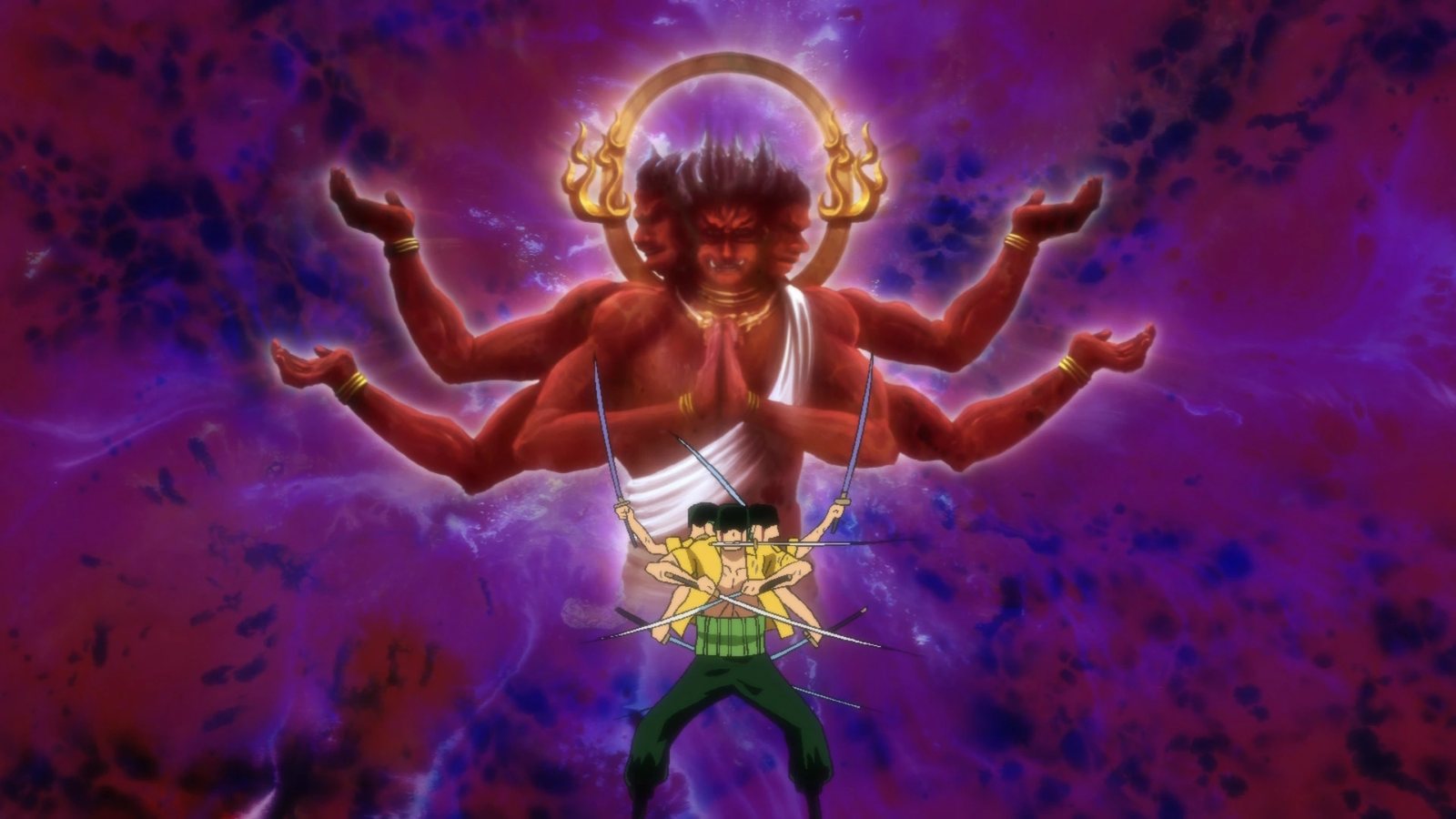
| Ashura Bakkei: Moja no Tawamure | Kaido | Chapter 1010 / Episode 1027 | Unconscious |
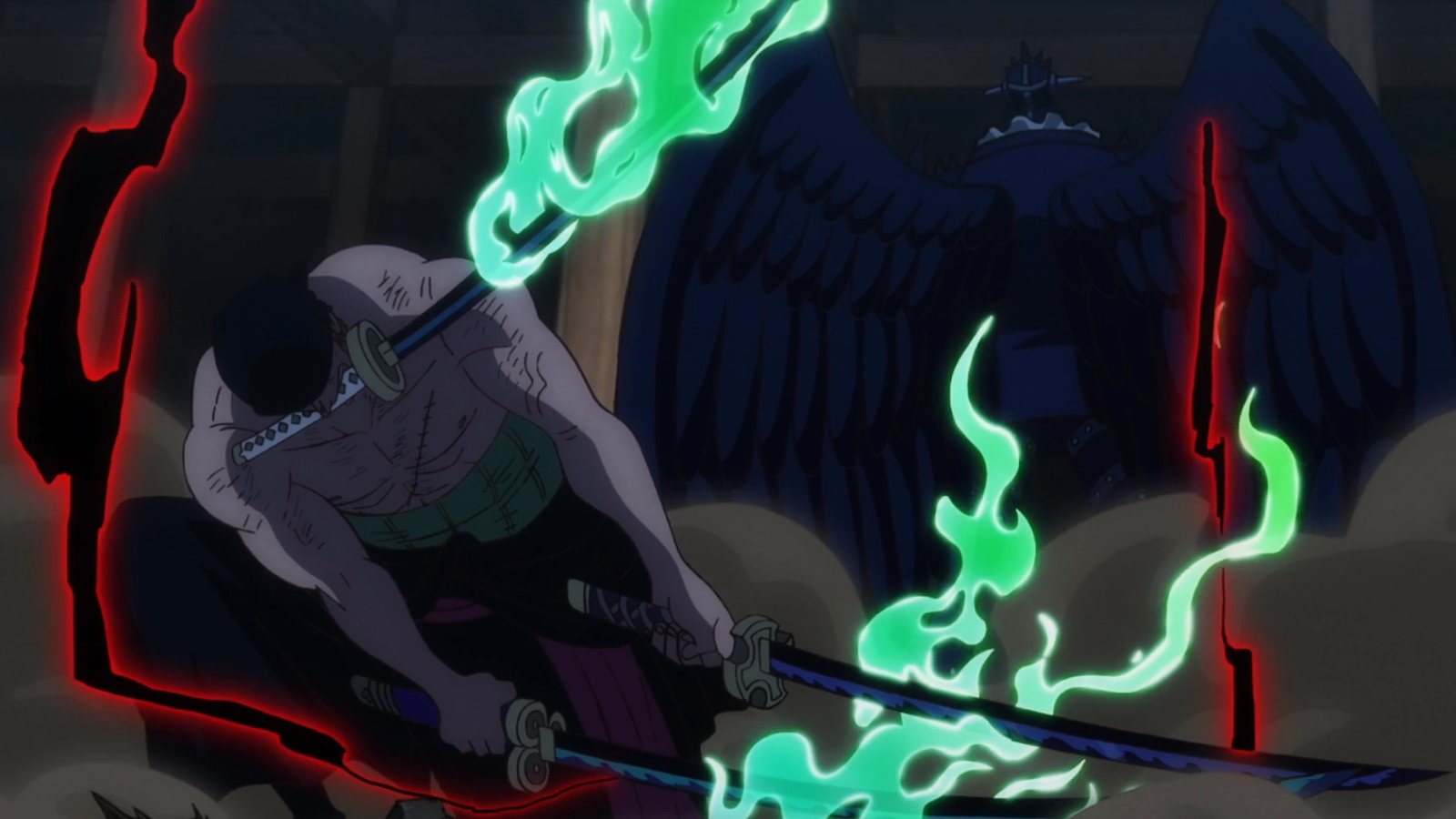
| King of Hell Three Sword Style: Rengoku Oni Giri | King | Chapter 1035 / Episode 1062 | Instinctive, through Enma |
| King of Hell Three Sword Style: Ippyakusanjo Hiryu Jigoku | King | Chapter 1035 / Episode 1062 | Instinctive, through Enma |
| Senhachiju Pound Ho (Conqueror’s-infused) | Sommers | Chapter 1194 / not yet animated | Deliberate |
What Price Does the Sword Enma Make Zoro Pay?
Enma is a sword that once belonged to Kozuki Oden, a character from Wano. Zoro used it for the first time in chapter 955. The slash brought down a whole cliff face, but the sword also drained Armament Haki from his right arm until it withered. (Armament Haki is the kind of Haki that hardens the body and weapons.)
Zoro wrenched back control, then realized he had to stop resisting. He let the sword take what it wants and expressed his full strength through it.
In OtaHub’s view, this is how Oda turns an abstract rule into something you can see. He does not explain how much willpower Conqueror’s Haki demands. He shows a sword that charges a bodily price, and anyone who cannot pay gets drained dry.
The name of the later state, En-Ō Santōryū (King of Hell Three Sword Style), follows the same idea. In Japanese culture, Enma is the king of the underworld who judges the dead. By naming a life-draining sword and a fighting style after that king, Oda makes the weapon read as part of the world, not just a toy handed to one character.
The price shows most clearly in the fight with King, Kaido’s subordinate (chapters 1033 to 1035, anime episode 1062). Zoro infused all three swords with both Armament and Conqueror’s Haki, but he still acted on instinct and some of the power leaked out. He can hold this state only briefly, because the cost could kill him.
Two attacks end the fight: Rengoku Oni Giri and Ippyakusanjo Hiryu Jigoku. Rengoku Oni Giri turns a close-range slash into a flying one. Ippyakusanjo Hiryu Jigoku splits King’s fire dragon in two and finishes the match. In OtaHub’s reading, Oda is doing more than “adding a move.” He shows the general rule of Conqueror’s Haki (infuse a weapon, strike at range) running through one swordsman’s body, with the bill attached.
Who Noticed Zoro’s Conqueror’s Haki Before He Did?
The first was an enemy. In chapter 1010, the Ashura Bakkei slash left a long scar across the chest of Kaido, the leader of the Beasts Pirates and the enemy Zoro faced in Wano. It was Kaido himself who said Zoro had just used Conqueror’s Haki. Zoro had no idea what he meant, and collapsed. The chapter is even titled “Haoshoku” (the Japanese name for Conqueror’s Haki), a small wink from Oda, since the reader is told first and the character is not.
The second was Scopper Gaban, a member of the Roger Pirates, in chapter 1152 on Elbaf. According to chapter summaries, Gaban remarks that Zoro carries the “color” of a conqueror. Zoro admits he had no idea. Luffy, his captain, adds that Zoro has been leaking Conqueror’s Haki all along.
Gaban then scolds him, saying that to help Luffy, Zoro must understand and control this power. The scene confirms a plot point and restates the nature of the rule at the same time, because people with Conqueror’s Haki recognize each other, like members of a secret society.
The anime adds an earlier moment that the manga does not have. In episode 984, Zoro hears Beasts Pirates mock Wano’s poor residents. He unknowingly releases Haki that knocks them all out, while he assumes they just drank too much. The moment is anime-only, but it fits how Oda tells this whole journey, with the reader understanding first and the character later.
How Is Zoro Tested on Elbaf?
On Elbaf, Oda builds Zoro’s opponent almost to measure. The Knights of God regenerate almost endlessly, and according to the story, ordinary sword strikes do no lasting damage. Gaban tells Luffy to watch how he uses Conqueror’s Haki, and says the Knights are not truly immortal. The story that follows puts Conqueror’s Haki in the position of the thing that can reach them.
So the question of the fight is no longer “is Zoro stronger than his opponent?” It is “does Zoro know how to use what he already has?”
Chapters 1193 and 1194 answer with training in the middle of a fight against Sommers, one of the Knights of God. Sommers realizes Zoro cannot yet control his Conqueror’s Haki and treats him like a punching bag. He even says this Haki cannot be unlocked through training alone. Zoro keeps cutting, a different spot each time, and Sommers keeps regenerating.
This passage speaks in pictures. The enemy proves the rule by confidently stating it, and the protagonist proves it by rattling him.
What Did Mihawk Tell Zoro?
The deciding beat of chapter 1194 is a flashback. Mihawk, the swordsman who once taught Zoro, says that everything changes, but one thing stays the same. As the translations convey it, Conqueror’s Haki is the power to sense one’s own strength, strong enough that the weak cannot stand before it.
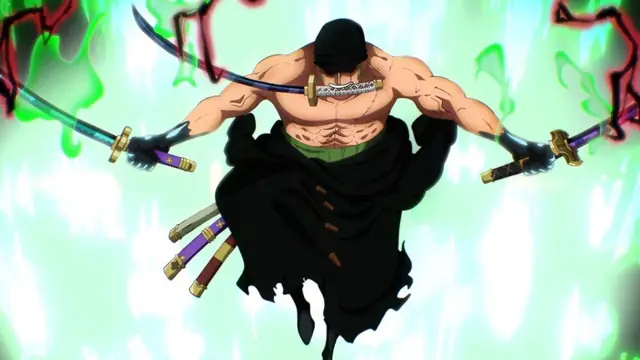
Zoro ties his bandana around his head and infuses all three swords. Black lightning and flames appear around the blades, much like in the fight with King. The difference is that this time he does it on purpose.
In OtaHub’s view, Mihawk’s line links a rare, innate rule to personality. Conqueror’s Haki is not a memorized technique but an expression of knowing who you are. That explains why Zoro, who swore to become the world’s greatest swordsman, can possess it before understanding it. It also gives Oda a way to place Mihawk in the story as a swordsman and teacher, with a line of instruction running from Mihawk to Gaban to Zoro without anyone needing to explain more.
What about the contradiction between “cannot be trained” and Zoro training mid-fight? One reading is that practice does not create Conqueror’s Haki. It only teaches someone who already has it how to hold it. That is OtaHub’s reading, since Oda has not said so outright.
Which Milestones Mark the Journey From Chapter 955 to 1194?
- Chapter 955: Enma drains Zoro’s Haki, hinting at the power hidden inside him.
- Chapter 1010: his first Conqueror’s infusion, noticed only by Kaido.
- Chapters 1033 to 1035: letting Enma draw out his Haki gives birth to King of Hell Three Sword Style and the win over King.
- Chapter 1152: Scopper Gaban confirms Zoro has Conqueror’s Haki.
- Chapters 1193 and 1194: he practices mid-fight against Sommers and infuses his swords on purpose.
Each milestone adds exactly one piece of information to the original rule, and none arrives as an exposition dump. In OtaHub’s view, that is why the whole journey reads like a world being built step by step, not a power-up chart.
Another Angle
There are two fair objections to this reading. First, “one in a million” is a rule Oda set early, yet the user list keeps growing: Luffy, Zoro, Kaido, Big Mom, Shanks, Roger, Whitebeard, Rayleigh, Gaban, Hancock. When most of the big names belong to the “one in a million,” you have every right to ask what the rule still means.
The story even jokes about it. In chapter 1152, Sanji eagerly claims to be the other user, but Gaban ignores him and points at Zoro. A power so rare that every important character has it becomes a badge for important characters.
Second, the whole journey can be read as a way to bring Zoro level with Luffy for the final stretch. Then it is a plot need, not a world design. That objection is not wrong, since Mihawk’s explanation arrives only after the power has been used many times.
But that is exactly why it suggests Oda chooses to tell it backwards, with use coming first and understanding later. Both readings have a place, and the next chapters will show how stably Zoro can hold this power.
In Short
Zoro’s Conqueror’s Haki journey shows Oda telling the story of this power through three concrete things: a short rule (rare, innate, tied to knowing who you are), a vessel with a price (the sword Enma), and a line of instruction (Mihawk, Gaban, and Kaido noticing from the opposing side). This piece shows that the approach is consistent from chapter 955 to chapter 1194. What it has not shown is how the “one in a million” rule holds up as the user list grows, or how Oda will handle Zoro having to use this power steadily.
Sources: Critical Hits (Zoro dominando o Haki do Rei); Sportskeeda (chapter 1152, Gaban and Zoro); SoapCentral (Zoro’s powers); We Got This Covered (Enma); Anime Explained (chapter 1194 summary); One Piece manga chapters 955, 1010, 1033 to 1035, 1152, 1193 and 1194 (Eiichiro Oda / Shueisha) and anime episodes 984, 1027 and 1062 (Toei Animation). Images are copyright of Eiichiro Oda / Shueisha / Toei Animation and used for informational purposes.