One Piece: Grand Gourmet puts Kairosoft on very familiar ground: a small restaurant, a list of goals and a loop of constant expansion. What is new is that this restaurant floats on the sea with the Straw Hat Crew, and Sanji runs the kitchen. The game launched on October 23, 2026 on Switch, Switch 2, Steam, iOS and Android, published by Bandai Namco.
The reviewer is a fan of both Kairosoft and One Piece, has waited a long time for this game, and played more than 15 hours on the mobile version. The question for this review is whether adding One Piece to the formula behind Cafeteria Nipponica and The Sushi Spinnery makes something new enough.
Does the restaurant loop still hook?
Each sea region, starting with the Sea of Beginnings, sets five goals. One of them is always to outsell the fake Baratie and the impostor Straw Hats. Another is usually to find a missing Straw Hat by pinning Wanted posters in the restaurant so certain guests give you clues. The rest revolve around turning customers into fans.
From those goals the loop runs clearly. You send Luffy out to Explore or fulfil guests’ wishes to receive blank recipes, gather ingredients from gifts, expeditions, shops or decorations, and then a character you just unlocked comes up with an idea and Sanji cooks the new dish. You group four dishes, a main, a side, a dessert and a drink, into a set to sell, then upgrade the set to draw more guests. The reviewer called this loop very satisfying, because after each small bit of time invested the game rewards you and gives feedback right away.
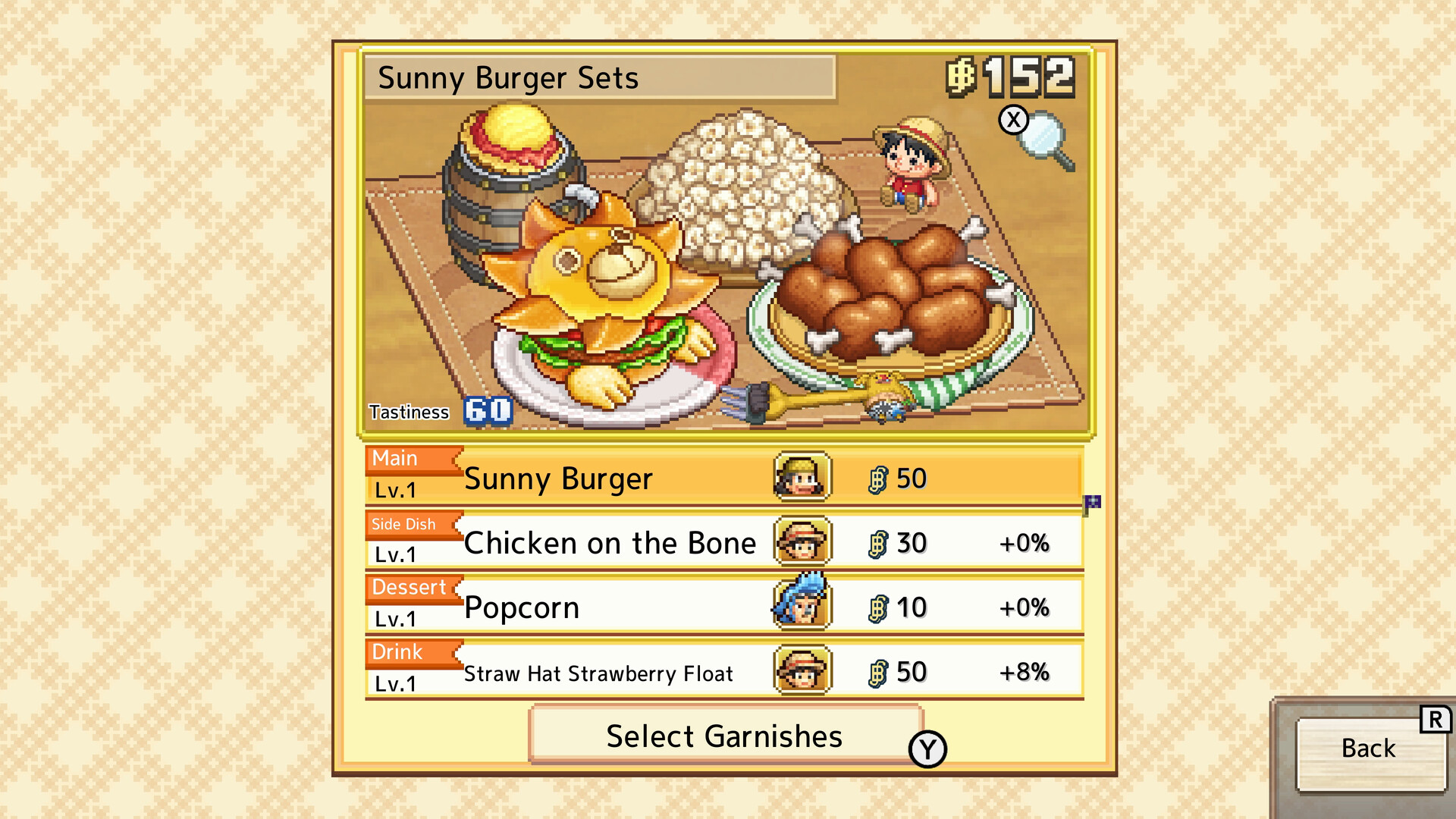
The game often asks for more than selling tasty dishes. Some guests only visit once a dish reaches a certain tastiness or level. Others will only come in if you renovate a corner of the restaurant around a theme such as the Marines or Drum Island, with an impressive dish to match. When you clear all the goals in a region, you enter a cooking battle against the impostors, where judges score the dishes you created and upgraded. This is where the sets you have built get tested.
That is also where the weakness sits. The formula is familiar from Kairosoft’s earlier games, and the reviewer found it more tiresome than expected. The plan to finish the game in three or four days faded after a few hours. The main reason is that the game crams in too much at once: regional goals, posters, gifts, fans, crew roles, sets, decorations. Even someone used to Kairosoft, like the reviewer, felt overwhelmed at times. So gameplay gets 8.5: absorbing and full of rewards, but not streamlined.
What does One Piece change in the old formula?
This is the clearest difference. The game opens with a shipwreck that scatters the Straw Hat Crew, leaving only Luffy and Sanji together. They spot a small copy of the Baratie fighting another ship, and Luffy accidentally wrecks it. Patty and Carne explain that people posing as Sanji and Luffy are running an impostor restaurant that harms the reputation of both the crew and the Baratie. With a new chef, the player’s character, and a chef duck named Tori, they open this small restaurant to clear their names, catch the impostors and reunite with their crew.
The story does not stay in the dialogue; it runs into the mechanics. Each region ties to places the Straw Hats have visited, and the guests are main or supporting characters from the series. Some demand that another guest appear first, others need one particular crew member to go with Luffy before a goal can be completed, and the link between them is already in the manga. Koby only becomes a fan if you give him a Marine cap. A Lapahn rabbit will eventually stand waiting for Dalton at some point.
The crew have jobs of their own, matched to what each does best. Robin handles improvements, Nami handles shopping and discounts, Usopp decorates, Zoro trains, and Franky renovates the ship. The reviewer felt Kairosoft uses the theme thoroughly: gifts, quests and each crew member’s role all have a reason rooted in the story, not just character art stuck onto a management game. Story and world get 9.2.
Does the pixel art capture One Piece?
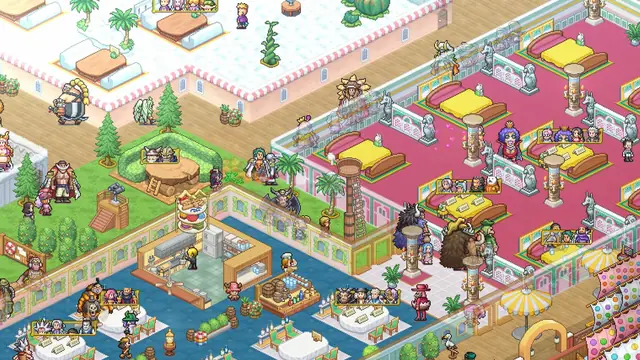
Kairosoft has always been strong at art direction for its management games, and Grand Gourmet is no exception. The characters and details of the series are redrawn in pixel art that is cute yet instantly recognisable. Every Straw Hat is easy to spot, and so is the supporting cast. The restaurant’s decor themes capture individual lands and factions, like the Alabasta style in the image below.
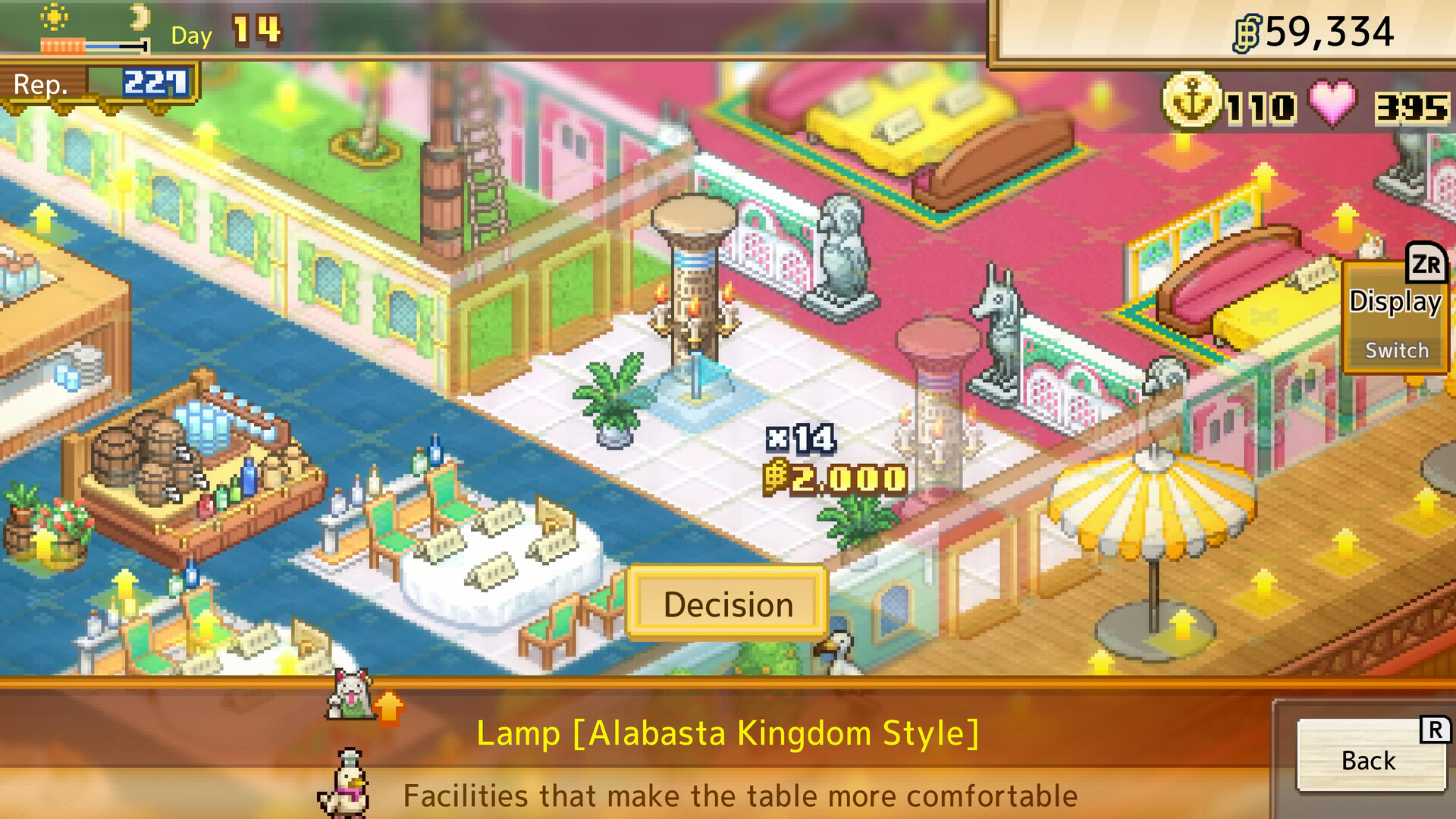
The reviewer found no weakness in the visuals, so this part gets 9.5.
How are the sound and stability on mobile?
The reviewer has no complaints about the sound. It was good enough not to get in the way across more than 15 hours of play, but nothing stood out enough to describe on its own, so this part gets 8.0.
On the technical side, the reviewer met no notable bugs on the mobile version. This only applies to the iOS or Android version the reviewer played, and OtaHub did not record the specific device. Technical gets 9.0.
Are 400 characters and 200 items enough to keep you playing?
According to Bandai Namco’s announcement, the game has more than 400 characters appearing for the first time in pixel art and more than 200 furniture and decorative items. Beyond the main goals there are plenty of side quests, and the game gives you reasons to return to regions you have cleared: anywhere not yet 100 percent complete is flagged with an exclamation mark in the menu or a note. What the reviewer enjoyed most was building the Baratie and its menu, from placing dishes into sets and dressing the plates to choosing the interior style. The role-playing elements make your choices change how the restaurant actually runs.
The value comes from that volume. It is the game’s greatest asset, but also the source of the overwhelmed feeling mentioned above. On Steam the game cost 299,000 VND when OtaHub checked on November 3, 2026, and Vietnamese is not in its language list. For the mobile price, and whether the mobile version has Vietnamese, check the App Store or Google Play. Value gets 8.8.
Verdict
Grand Gourmet turns the restaurant into a place to meet familiar One Piece faces again, with dishes, gifts and quests that all have a reason in the story. Its biggest limit is not too little content but too much. The familiar Kairosoft formula and the number of systems can cool your enthusiasm, even for a die-hard fan.
It suits people who like both restaurant-management sims and One Piece. The reviewer would not yet recommend it to someone who only loves One Piece and is unfamiliar with the genre, because this is a restaurant-management game, not an action game. On PC, some Steam players also criticise choosing and placing items with the mouse, something the reviewer did not meet while playing on mobile.
The total is the weighted average of the six game criteria; editors may adjust it by up to ±0.2. See our review standards.
OtaHub recommendation: Worth buying
Review scope: the mobile version (iOS or Android, device and version not recorded), played for more than 15 hours. OtaHub has not played the Switch, Switch 2 or Steam versions. Illustrations come from the game’s Steam page.
Sources: Bandai Namco Entertainment Europe’s announcement (release date, platforms, number of characters and decorations) and the game’s Steam page (developer, publisher, price, languages, images). Read on November 3, 2026.
Image credit: Kairosoft / Bandai Namco (screenshots from the game’s Steam page).