In-Depth · Legacy & Retrospective · Spoilers (through the ending)
Laputa: Castle in the Sky is a Japanese animated film that opened on August 2, 1986 and earned less than expected. Forty years later it is back in Vietnamese cinemas from September 25, 2026, and it still sells tickets. In OtaHub’s view, it has lasted for two reasons: its question of who holds power has never gone out of date, and it became shared property among viewers in a way few films manage.
What Is Laputa, and Why Did It Disappoint in Theaters?
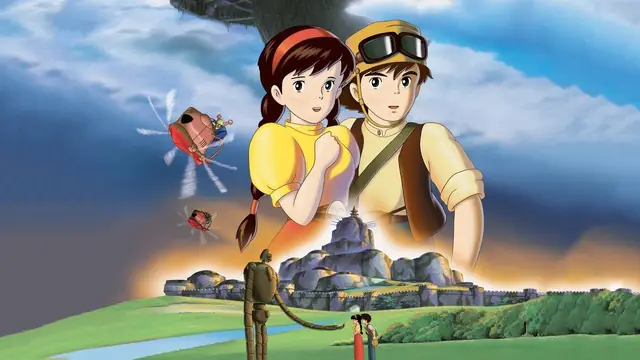
Laputa: Castle in the Sky is a feature-length animated film written and directed by Hayao Miyazaki. Isao Takahata produced it and Joe Hisaishi composed the music. According to Wikipedia, Studio Ghibli, the well-known Japanese animation studio, opened on June 15, 1985. Laputa was the first film released under the studio’s name.
The film opened on August 2, 1986 in 103 theaters. In its first two weeks it drew 774,271 viewers. Also per Wikipedia, it earned only about two-thirds of what Miyazaki’s earlier film Nausicaä did, which was below expectations.
That detail turns the usual Ghibli story upside down. The studio was young, and the film did not catch fire in theaters. Yet in OtaHub’s view, it outlived many hits of its day. Per Wikipedia, it won the Ōfuji Noburō Award at the Mainichi Film Awards and the Anime Grand Prix from the magazine Animage. Years later it still appears in polls of the greatest animated films by Japan’s Agency for Cultural Affairs and Oricon.
What Is the Story, and What Question Does It Ask?
The name Laputa did not come from Miyazaki. It is the flying island in Jonathan Swift’s novel Gulliver’s Travels, published in 1726. In the book, the island floats on magnetic minerals above the kingdom of Balnibarbi. Its inhabitants are absorbed in abstract theory, and Swift used that to satirize the scientists of his day.
Miyazaki took the name and the idea of a flying island but dropped the satirical tone. He turned it into an adventure that races against time. Then he put a more serious question inside it: who holds power, and what do they use it for?
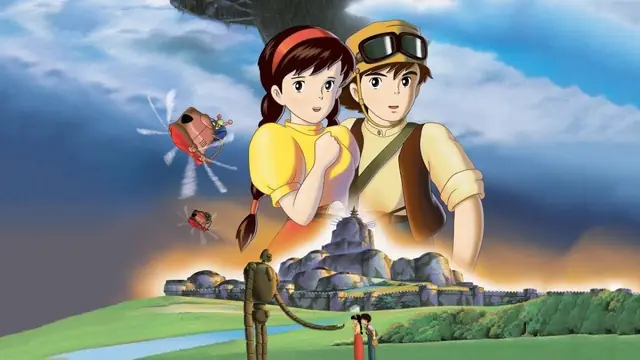
The question shows most clearly in the villain Muska. He wants to seize Laputa and use its power to rule the ground below. Sheeta, a girl who carries the flying crystal and the blood of Laputa’s royal line, chooses to give that power up.
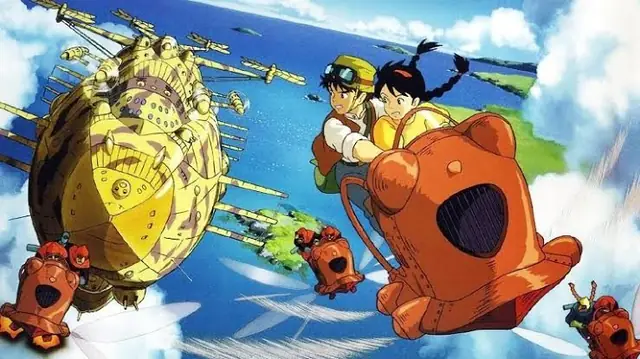
The film never says technology is bad. On the island there is a robot gardener that is both a frightening war machine and a caretaker of plants and birds. In other words, the same engineering can destroy or nurture. In OtaHub’s view, that is why the message has not dated, because it does not belong to a particular technological era but to the question of who holds the tool and what for.
The ending is where the message completes itself (spoiler). Pazu, a boy who lives in a mining town, speaks “balse” together with Sheeta, which is the spell of destruction. The base of the island collapses, while its core and its great tree rise into the sky, out of reach of anyone who wants to use it as a weapon. The film chooses to end by giving power up rather than seizing it.
Where Did the Mining Town and the Music Come From?
The mining town where Pazu lives goes back to a real trip. According to Wikipedia, Miyazaki traveled to Wales in 1984, just as the coal miners’ strike of 1984 to 1985 was under way. He returned in May 1985. The Cultural’s analysis of the film says he passed through mining towns in the Rhondda Cynon Taf area and visited several Welsh castles. The Big Pit mine, per Wikipedia, inspired the mining-village scenes in the film.
From there, Pazu’s town can be read as a record of memory. It has terraced houses filled with smoke and miners who treat Pazu as family, a working community that still keeps faith with its own. The Cultural also notes that the strike ended in defeat and that tens of thousands of Welsh mining jobs disappeared. In a 2005 interview with The Guardian, cited in this article’s sources, Miyazaki spoke of the miners as a vanishing breed of people. He compared that to the fate of handcraft. OtaHub reads this as the reason the ordinary-people scenes in Laputa feel warmer and more concrete than the politics on the island, since he was writing about people he had seen with his own eyes.
The music has its own story. According to Wikipedia, Hisaishi began composing in February 1986. The music for the opening scene was finished less than a month before release. The score was recorded by the Tokyo City Philharmonic, and the film was among the first Japanese theatrical releases to use four-channel sound.
The more interesting story is the second score. In 2003, Disney released an English-language dub of the film. Hisaishi rewrote the music for it, working from March 1999 in an “American cinematic style.” The new score runs roughly 90 minutes against about 60 for the original, and the Seattle Symphony performed it. Wikipedia notes that he first had to reconstruct parts of the original score that had been lost.
A composer returning to his own work thirteen years later says what Japanese audiences already knew. Laputa’s music does more than accompany the images, because it carries half the film’s pacing. Which version you prefer is personal, but the fact that two exist shows how much emotional weight the film carries.
What Is “Balse,” and How Did the Film Live On After Its Theatrical Run?
The modest box office is not the end of the story. According to Wikipedia, the TV network Nippon TV broadcast the film repeatedly from 1988 to 2004, with ratings between 12 and 22%. The 1998 VHS reissue sold roughly one million copies. The film truly grew up in living rooms.
That led to a phenomenon no other film has. “Balse” is the spell Pazu and Sheeta speak in the final scene. Each time the film airs on Japanese television, viewers type the word “balse” online at the same moment that scene arrives.
According to Global Voices, during the 13th broadcast on December 9, 2011, “balse” was posted 25,088 times per second on Twitter. That was a Twitter record at the time. On August 2, 2013, during a Nippon TV broadcast, Japanese users set a new record of 143,199 tweets per second. It is a rare legacy, since a film scene turned into a collective ritual, and the scene is one about giving up power.
How Is the Film Returning to Cinemas in 2026?
2026 marks the film’s 40th anniversary. Per Cartoon Brew, GKIDS (the film’s US distributor) and Fathom (a company that runs special cinema events) brought it back to US theaters as part of Studio Ghibli Fest 2026, starting August 22. Screenings come in both the original Japanese and an English dub, and each includes a clip from the bonus featurette “The World of Laputa.”
In Vietnam, the ticketing site Momo lists a release date of September 25, 2026. The original Japanese voice cast is listed as Keiko Yokozawa (Sheeta) and Mayumi Tanaka (Pazu). The page does not say whether screenings are subtitled or dubbed, nor which distributor or cinema chains are involved, so check before booking. Vietnam’s Báo Văn hóa earlier reported that CGV would screen 21 Ghibli films over four years from late 2024. That article does not mention Laputa, so OtaHub is not tying this run to that program.
Later box-office figures suggest the film does not live on nostalgia alone. Wikipedia compiles international re-release earnings at US$6.6 million for 2003 to 2019 and US$19.8 million for 2020 to 2026. The film opened in Chinese cinemas on June 1, 2023 with 76 million yuan in its first week. As of 2026 it has earned about US$16.5 million there. In OtaHub’s view, a forty-year-old film still selling tickets to people who never saw it on a big screen is a clearer sign than any praise.
Another Angle
The thesis that the film lasts because of its message can be challenged in three ways. First, its staying power may owe more to nostalgia and childhood memory than to the message. In Japan, rewatches are tied to the habit of watching together on television. Vietnamese audiences going to cinemas now come partly for the Ghibli name. The nostalgia is real, but it does not prove the content is still doing the work.
Second, the idea that “technology can nurture or destroy” is quite familiar to audiences today. New viewers may find the ending tidy. Muska is also a more straightforward villain than many characters Miyazaki wrote later. That is OtaHub’s own view, not data.
Third, the English dubs drew mixed reactions, according to Wikipedia. The film’s legacy is therefore not uniform across markets. In Japan it is something a whole country watches together. Elsewhere it arrived later and through several different versions.
In Short
This article established three sourced points: Laputa was the first film under the Ghibli name and disappointed in its first theatrical run; it lived on through television, music and the “balse” ritual; and its re-releases from 2003 to 2026 still sell tickets. What it did not establish is that the message about power and technology is the main reason for that longevity, since it cannot be separated from nostalgia and the Ghibli brand. If you have seen the film, this year’s cinema run is a chance to rewatch it with the ending in mind. If you have not, you are about to watch a forty-year-old film that still asks the right question.
Sources: Wikipedia: Castle in the Sky, Wikipedia: Laputa, The Cultural: Laputa and the Welsh miners’ strike, Global Voices: tweets-per-second record, Cartoon Brew (Studio Ghibli Fest 2026) and the Momo ticketing site.