In-Depth · Characters · Spoilers (through the base game's endings)
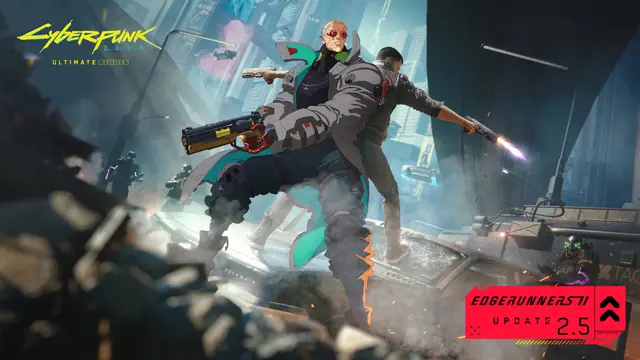
In Cyberpunk 2077, Johnny Silverhand is a rebellious rock singer who is already dead, but a copy of his consciousness lives inside V's head, the character you control. At one point he even asks V to lend him their body for an evening so he can meet his ex. So is he a hero or a selfish man? In my reading, the answer lies in the moments when he has to hear someone else say "no."
Warning: this piece contains story spoilers for Cyberpunk 2077.
V is a mercenary in Night City, the game's future metropolis. After a heist goes wrong, V carries a chip in their head holding a copy of Johnny's consciousness. Johnny was the lead singer of the rock band Samurai and an enemy of the Arasaka corporation. The chip slowly overwrites V's mind with Johnny's, and if it finishes, V will be gone. So two strangers with two different personalities have to share one body while they look for a way to coexist.
Fighting the corporations: a war for freedom or a personal grudge?
Arasaka is a giant corporation that controls the technology for copying a human mind into data. That means a person's memories and personality can be taken from their owner and end up in the hands of a company. Johnny hates Arasaka because of that very concrete fear.
Before he became a singer, Johnny served as a soldier and fought in a war in Central America. Those experiences helped shape his hostility toward powerful institutions. After leaving the army, he and Samurai used music to fight the order he despised.

Johnny has good reason to hate Arasaka. But that reason doesn't answer another question: who is he willing to make pay the price alongside him? The question shows itself when you look at how he treats the people close to him.
What do Johnny's memories show, and why read them with care?
The game lets you relive two of Johnny's memories, ten years apart, in which he goes up against Arasaka. In the quest Never Fade Away (2013), Arasaka kidnaps Alt Cunningham, Johnny's girlfriend, and he tries to rescue her. In the quest Love Like Fire (2023), Johnny leads the assault on Arasaka's tower, a plan that includes a nuclear bomb. At the end of this memory, an Arasaka assassin shoots Johnny. The corporation takes him alive, then uses its consciousness-copying technology to turn him into data stored in its archive. His body dies, and the chip in V's head holds that copy of his mind.
Because you control Johnny directly, these memories feel very convincing. But they are still memories stored in a copy of his mind, so they only show how Johnny remembers events. Alt also tells V that Johnny's memories carry his own point of view and have shifted over time. By then Alt is no longer a flesh-and-blood person but a digital mind living in cyberspace, and V meets her there.
A shifted memory doesn't prove he deliberately told the story wrong. It only shows that the flashbacks need careful reading. In my reading, the more interesting part is the gap between the Johnny of the flashbacks, who tells his life as a war, and the Johnny who has to listen to others talk about him.
What do Alt and Rogue show about Johnny's other side?
Alt Cunningham: love, or a wish to hold on to the past?
Alt is more than Johnny's girlfriend. She is a talented netrunner (a hacker who breaks into networks) with her own goals and choices, and she created the consciousness-copying technology that Arasaka uses. Johnny rescues her out of love, but the way he sees Alt sometimes looks more like a man trying to keep the past alive than someone trying to understand what she actually wants.
When V meets Alt in cyberspace, she is already different from the woman in Johnny's memories. If he keeps looking at her through their old relationship, it will be hard for him to understand what she wants now.
Rogue Amendiares: someone who no longer wants to live in the past
Rogue is Johnny's ex, so she knows him very well: charismatic and rebellious, but also hot-tempered.
In the quest Chippin' In, V lets Johnny borrow the body for a while to reach Rogue, then wakes up after the time he used it. The quest ends at Johnny's grave in the oil field, where his real body is buried, and V talks to him there. If you choose friendly lines with Johnny and call Rogue, you unlock Blistering Love: a date at the drive-in theater, where V takes a pill so Johnny can control the body for an evening with his ex. Even a meeting between two former lovers still depends on V giving up their body.
Meeting again doesn't erase the past. Rogue has her own life now, and I get the sense that Johnny slowly understands he can't expect others to come back the way they were just because he wants it.
Does Johnny really learn to think about others on V's journey?
His relationship with V is the most important part of the character. The chip does overwrite V's body bit by bit, but that is how the chip works, so not every harm V suffers can be treated as something Johnny did on purpose. To judge his responsibility, you have to look at the moments when he could keep his word, accept a limit, or use the permission V had given him.
Chippin' In is the clearest test. V lends the body, Johnny gets the information he needs, but V wakes up after the fact and has reason to object. Being helped doesn't mean Johnny is automatically free to do whatever he wants.
At the oil field at the end of the quest, the positions are reversed. Johnny stands in front of his own grave, and V can question him and decide whether to give him another chance. I like this part: he has to hear the judgment of someone who has been with him through a lot, and he can't just declare that the two of them have made up.
The Temperance ending: a second chance, or an atonement left unfinished?
Temperance is one of the game's endings. Johnny keeps V's body and goes on living, while V leaves the body and goes into cyberspace with Alt. You can reach this ending through Panam's path (she is one of V's companions), through Rogue's path, or through Johnny's secret path.
The decision works differently on each path. On Panam's path, you control V and choose both of their fates. On Rogue's path, you are playing as Johnny, so the decision to keep or return the body is made from his side. This difference matters if you read Temperance as a sacrifice. When V gives up the body, Johnny receives his chance at life from V's choice. When Johnny makes the decision himself, the question shifts to whether he respects what V wants.
In the closing scene, New Dawn Fades, Johnny buys a guitar, goes to V's memorial to leave something behind, then boards a bus out of Night City. That quiet scene shows the cost of a second chance: V is no longer there to remind him or object. That chance at life only means something if Johnny takes responsibility for the very body he borrowed.
The other side of the argument: is he really selfish?
There is an opposite reading: Johnny isn't selfish, he is just a rebel to the end. This reading has merit. He fights Arasaka with his whole life, and most of the harm V suffers comes from the chip, not from his wishes. He also gives way at times, for example when he accepts that V has the right to question him at the oil field.
But many times he still wants to decide in V's place, and his willingness to use V's body to meet an ex shows that the line between asking for help and taking someone else's say is fairly blurry for him. That's why I don't choose "hero" or "selfish man." Both labels are too simple for someone who dares to take on a corporation and also has to learn to leave room for other people.
When does Johnny change?
Not when he hates Arasaka less. He still fights the corporation, and there is still a lot to blame him for. His change is only tested when he has to hear something he doesn't want to: V questioning him at the oil field, Rogue having a life of her own, and V no longer being there while he lives on. Those scenes let you see Johnny as someone learning to take responsibility. But the game also lets players pick paths that make that reading hard to hold, so saying he has fully atoned ignores the very choices that give the character his weight.
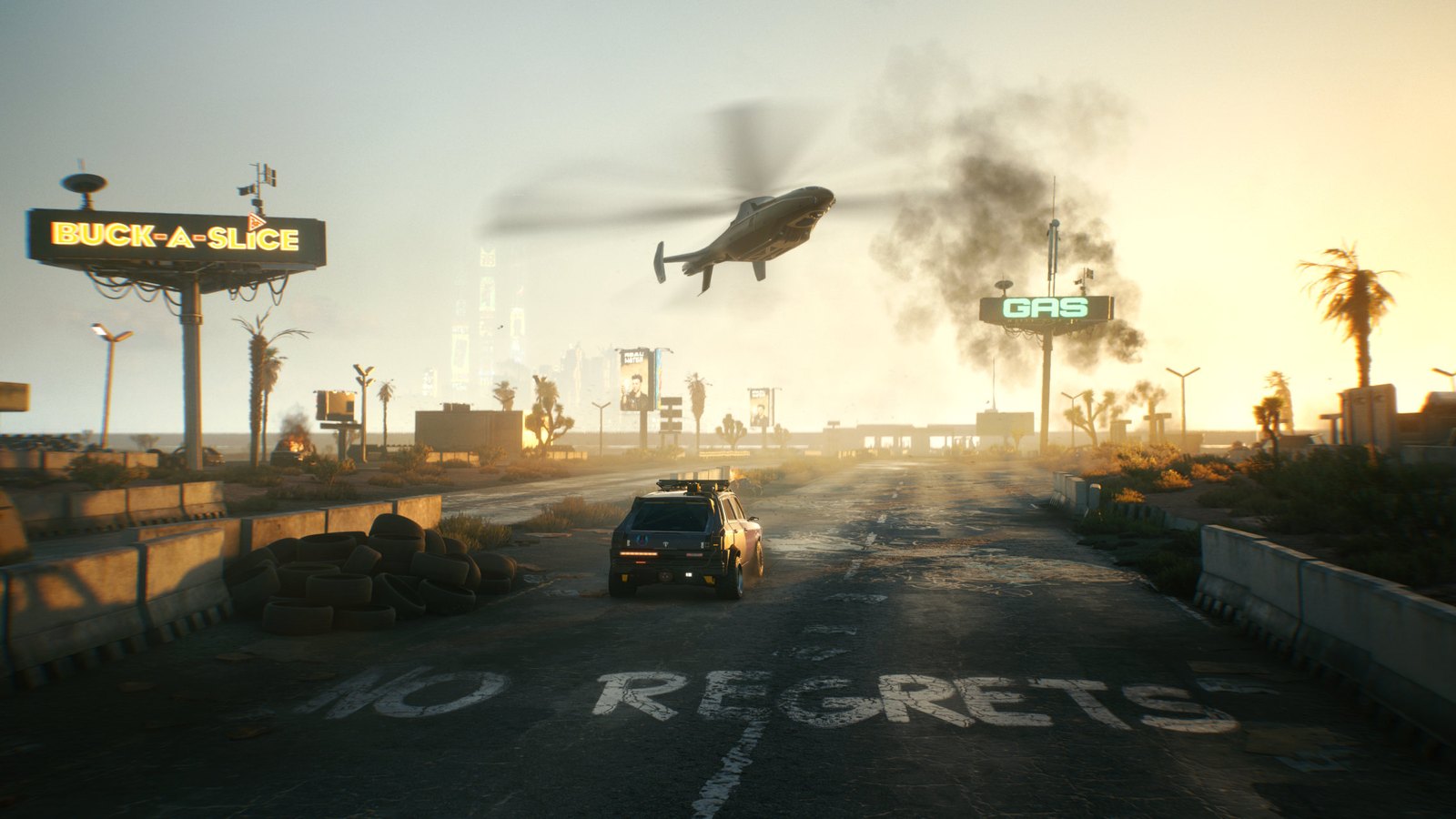
What I remember most about Johnny is the moment he has to accept that other people have the right to tell him no. Fighting Arasaka gives him an enemy to fight. Living with V forces him to learn how to treat a person he needs, has hurt, and may owe for the rest of his life.
Sources: the Never Fade Away page on the Cyberpunk Wiki (the 2013 memory and Alt's kidnapping); PowerPyx's Chippin' In walkthrough (the quest ending at Johnny's grave, calling Rogue); PowerPyx's Blistering Love walkthrough (the drive-in date, V handing over control); RPG Site's endings guide (Temperance and the paths leading to it); the New Dawn Fades page on Fextralife (the closing scene: the guitar, the memorial, the bus out of the city); GamingBolt's Johnny biography (military service, the Central American war, the Arasaka Tower assault). The cover image is official art from the Phantom Liberty expansion, and the other images are official promotional images, all from CD Projekt Red's cyberpunk.net. Checked on November 19, 2026.