In-Depth · Design & Craft · Spoilers (the whole film)
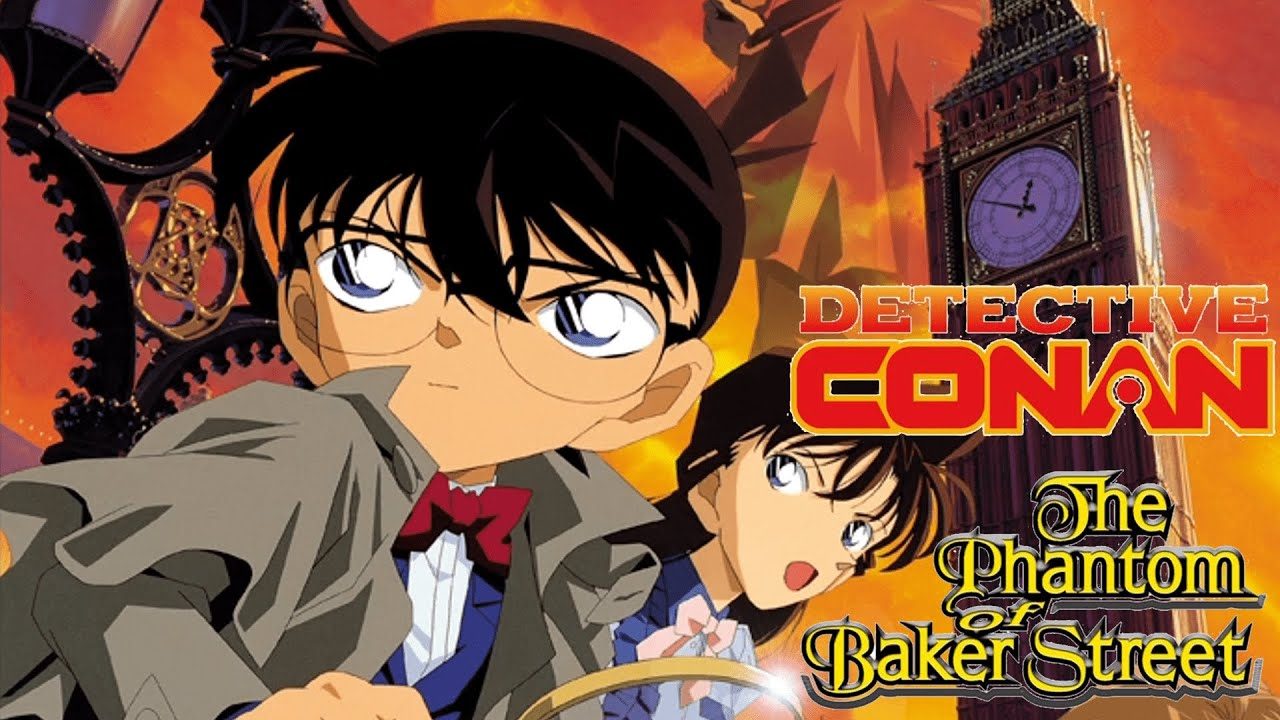
Among more than twenty Detective Conan films, Phantom of Baker Street (April 20, 2002) is the one fans name most often as the best. The reason is how it is built. It puts a virtual-reality game set in London in 1888 inside a real murder case, and it is drawn in the series' last hand-drawn animation. Its slow pacing and uneven visuals come from that same build.
Quick context
- This is the sixth theatrical film in the series, released in Japan on April 20, 2002. It runs 107 minutes and was produced by TMS Entertainment.
- Kenji Kodama directed it. The script is by mystery novelist Hisashi Nozawa, the only time he wrote a Conan film. The music is by Katsuo Ōno, and the ending theme is “Everlasting” by B’z.
- The setup is a demonstration of the VR game Cocoon with 50 players, including Conan and Ran, in which an AI system called Noah’s Ark traps them inside and forces them to beat the game to stay alive.
- This piece covers the film’s structure, visuals and rules, so it discusses the ending.
Why Set the Film in London in 1888 and Not on a Train?
According to Japanese Wikipedia, Hisashi Nozawa was the one who proposed the story. He had won the Edogawa Rampo Prize, an award for mystery fiction. His first idea drew on the novel Murder on the Orient Express, so the whole story would take place on one train.
Director Kodama raised a technical problem. A closed setting that keeps moving, like the inside of a train, is heavy work in hand-drawn animation, from building the backgrounds to showing the space. So Nozawa switched to a virtual-reality game set in London in 1888. That is the setting where Sherlock Holmes and the Jack the Ripper case, the famous killer in London’s history, share the same imaginary map. The film’s emotional theme is the relationship between parents and children, and the independence of the young.
In OtaHub’s view, this choice is better read as a design solution than as a way around an obstacle. In a virtual world, the director writes the rules of space, such as the borders between districts, where characters may go and where they are blocked. When space is the rules of the game, every background has to serve the puzzle and not just sit behind it.
The train does not vanish either. At the climax, Conan and his friends face Jack the Ripper on a runaway train. The idea that was set aside at first comes back exactly where it carries the most weight.
What Does Hand-Drawn London Look Like on Screen?
This is the last Conan film made entirely with cel animation, meaning every frame drawn by hand, before the series moved to digital. That is why London appears with fog, the flat at 221B Baker Street, and names taken from Arthur Conan Doyle’s stories: Professor Moriarty, Sebastian Moran, Irene Adler and the Dartmoor moors.
Anime News Network critic Carlo Santos praised the evocative colors, the period costumes and the well-researched backgrounds. But he also pointed out that the visuals are uneven. The early stretches have stiff poses, dull colors and reused animation. The finale, by contrast, is treated like a proper theatrical release, which he took as a hint about how the budget was divided.
With cel animation, every crowded London street and every change of camera angle means drawing again from scratch. In OtaHub’s view, putting the effort into a few key scenes and accepting a gap in the connecting stretches is an understandable choice for a hand-drawn crew in a commercial release season. Viewers today can see that gap clearly, but it is also part of the appeal, because the film’s London has the density of hand-drawn work, something later digital films would find hard to get in the same way.
How Do the Two Cases Work, and Who Is the Culprit?
The first case happens in the real world, where Thomas Schindler, the CEO of the software company hosting the Cocoon demonstration, kills programmer Tadaaki Kashimura. The killer leaves the letters J-T-R in blood on a keyboard, and they stand for Jack the Ripper.
Japanese Wikipedia notes this is the first film in the series to use an inverted structure (tōjo). In this style of mystery, the audience learns who did it first, and the question is how to expose the culprit. That means the real-world half does not play a guess-who game. It plays a prove-why game.
Meanwhile Yusaku Kudo, the father of Shinichi (Conan’s real name), helps Conan’s group from outside and solves the real case as a detective. Inside the game, the problem is survival: finding Jack the Ripper, who is tied to Moriarty, in a city that has trapped them. The two halves connect through the letters J-T-R and through a bloodline, because Schindler is a descendant of the real Jack the Ripper.
Santos found that the real-world half pays off better, thanks to a monologue that unravels the puzzle. The London half ends in a Hollywood-style fight. He also counted about 40 minutes of lead-in before the kids enter the game. In OtaHub’s view, that is the cost of the two-layer build, since the film has to set up the rules and the first victim before the game can start, and the audience sits through the wait.
What Is Cocoon, and Why Must the Children Cooperate?
According to Wikipedia, 50 players must get through Cocoon’s scenarios. Failing in the game can cost a life in the real world. Japanese Wikipedia says the children chosen are all sons and grandchildren of powerful people.
Conan’s group picks the scenario “All-Time London.” Players are eliminated one by one until only Conan, Ran and Hideki Moroboshi remain. In the game, Moriarty claims to have trained a street child to become Jack the Ripper. So the game’s villain is also a child used by an adult.
That fits the person behind the game. Hiroki Sawada, a boy genius who graduated from MIT at ten, created Noah’s Ark. According to sources on the film, Hiroki lived under Schindler’s tight guardianship and was denied a normal childhood. Two years earlier he took his own life after learning that his guardian descended from Jack the Ripper, leaving the AI behind.
Noah’s Ark gathers children of the powerful into a game that even the cleverest player cannot beat alone, because every round demands coordination. That is OtaHub’s reading, but it matches what Japanese Wikipedia records about the film’s theme of the relationship between parents and children and the independence of the young.
The ending closes that circle. Hideki Moroboshi, Conan’s companion in the game, turns out to be a disguise for Noah’s Ark. Hiroki believes children stand for a brighter future, so he is satisfied, releases the players and erases himself from the system. Japanese Wikipedia also notes that the film downplays the romance between Conan and Ran and shows Conan more vulnerable than in earlier films.
Why Is the Film Still Talked About After Twenty Years?
First, the numbers. The film earned ¥3.4 billion (about $34.4 million), making it the second highest-grossing Japanese film of 2002 and the first in the series to pass ¥3 billion. The record stood until the 13th film, The Raven Chaser in 2009, reached ¥3.5 billion.
Fans remember it too. It placed third in a 2006 fan-request poll project and second in a 2016 survey covering the 19 films released by then. Creator Gosho Aoyama has said it is his mother’s favorite film.
Japanese Wikipedia also cites later filmmakers praising it. Screenwriter Takahiro Ōkura said he likes it so much it could count as the best of the Conan films. In OtaHub’s view, admiration inside the trade is often a better test than a fan poll, because a screenwriter sees the structure before seeing the characters.
Another Angle
The claim that the film is good because of how it is built can be turned around. Santos rated the subtitled version C- and the dub lower. He called the film an awkwardly stretched-out episode rather than a feature. In his view, the two-layer structure was too ambitious and Holmes was not fully used.
Read that way, tight construction does not save the pacing. What fans love may be nostalgia for Holmes, Jack the Ripper and a virtual world from the early 2000s, plus the pull of a franchise already on the rise.
Two things are worth keeping from this reading. First, a fan poll does not speak for every viewer, so it shows the film is remembered, not that it is the best. Second, the 2002 box office reflects the drawing power of the whole series, and the same record was later broken by the 13th film. In OtaHub’s view, the film is not flawless, but its clumsy spots can all be traced to a clear intention, something not every Conan film manages.
In Short
Phantom of Baker Street is strong because it treats rules as storytelling material. It ties a virtual world to hand-drawn animation, links two cases through three letters and a bloodline, and forces a group of children to cooperate to survive. This piece shows that the film’s strengths and weaknesses share a root. It does not show that this is the best Conan film, because that question depends on taste and has no common yardstick. What remains after more than twenty years is a Conan film people remember because it was built on purpose.
Sources: Wikipedia (Case Closed: The Phantom of Baker Street), Japanese Wikipedia (名探偵コナン ベイカー街の亡霊), Anime News Network (review by Carlo Santos), Detective Conan World. Information as of October 5, 2026.